
Views: 0 Author: Site Editor Publish Time: 2026-10-06 Origin: Site


Invisible dust can cause serious damage to expensive electronics and mechanical systems. Microscopic particles can infiltrate poorly sealed enclosures, leading to short circuits, overheating, optical contamination, and mechanical wear.
To identify these risks before products reach the market, engineering teams rely on controlled environmental simulation. A dust test chamber allows manufacturers to evaluate enclosure sealing, particulate resistance, and product reliability under repeatable laboratory conditions.
In this guide, we explore the practical applications of dust testing equipment, including automotive components, consumer electronics, ingress protection testing, key standards, and important chamber specifications. LIB Industry provides dust test chamber solutions for IP testing, automotive components, electronics, telecommunications equipment, and other industrial applications.
Essential Quality Control: Dust testing helps verify enclosure integrity and product reliability before mass production.
Global Benchmarks: IP5X and IP6X are widely used ratings for evaluating protection against solid particulate ingress.
Automotive Safety: Dust simulation helps evaluate components such as sensors, EV battery systems, lighting, and electronic enclosures.
Risk Reduction: Early testing helps manufacturers identify sealing weaknesses before products enter the market.
Equipment Selection: Choosing the right chamber requires consideration of IEC 60529, specimen size, airflow, heating, vacuum control, and dust type.
A dust test chamber is an enclosed environmental testing system designed to reproduce dusty or particulate-heavy environments.
Its main purpose is to evaluate how effectively an enclosure protects internal components from solid foreign particles.
Depending on the required test method, the chamber may circulate:
Fine talcum powder
Arizona Road Dust
Silica-based test particles
Other standardized particulate materials
By creating a controlled particulate environment, engineers can identify where and how dust penetrates a prototype or finished product.
LIB Industry dust test chambers can be configured for different particulate testing requirements, including standard IP ingress evaluations and more demanding industrial applications.
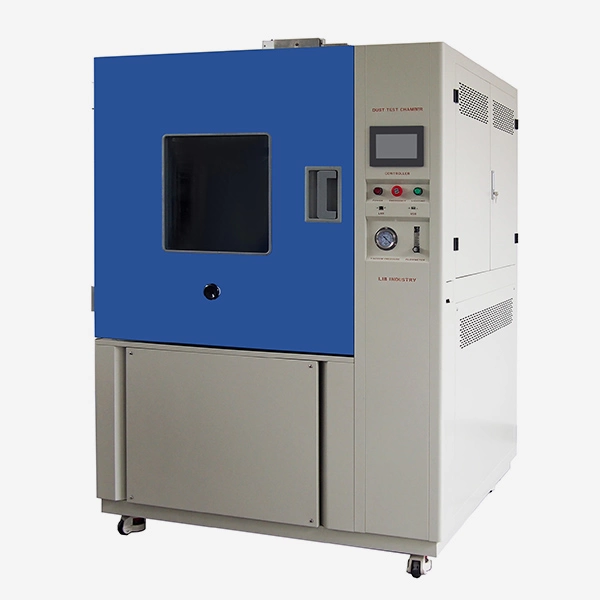
The operation of a dust chamber depends heavily on airflow and particulate circulation.
At the bottom of the chamber, a funnel-shaped hopper collects the test medium. Blowers, pumps, or compressed-air systems then circulate the dust back into the workspace.
The objective in standard dust testing is usually not to blast the product directly with high-speed air. Instead, the chamber creates a relatively uniform cloud of fine particles around the specimen.
Vibration mechanisms may also be used to prevent powder from accumulating on chamber surfaces.
This helps maintain more consistent particulate distribution throughout the test cycle.
Changes in product temperature can create internal pressure differences during real-world operation.
When internal air contracts, outside air and suspended particles may be drawn through weak sealing points.
For this reason, some dust test procedures use an integrated vacuum system.
The vacuum pump connects to the internal cavity of the Device Under Test and draws air through the enclosure at a controlled rate.
This negative-pressure method is especially important for higher-level reliability testing, including certain IP6X procedures.
The development of autonomous vehicles, electric vehicles, outdoor electronics, and telecommunications infrastructure is creating more demanding particulate testing requirements.
Vehicle-mounted LiDAR, cameras, and sensors may operate continuously in dusty road environments.
EV battery systems must protect high-voltage electrical components from contaminants.
Outdoor communication equipment may be installed in deserts, industrial zones, or other high-dust environments.
As a result, manufacturers increasingly require both traditional settling dust testing and more aggressive blowing sand simulations.
For consumer electronics, miniaturization also increases sensitivity to contaminants.
As electronic components and connection points become smaller, even tiny particles may interfere with thermal management, electrical performance, or mechanical operation.
Particulate ingress can damage products in several ways.
Abrasive sand can accelerate wear in mechanical systems and damage moving surfaces.
Fine dust inside electronic equipment can:
Accumulate on circuit boards
Reduce heat dissipation
Contaminate connectors
Affect insulation
Obstruct optical components
Interfere with moving parts
In humid environments, accumulated contaminants may also absorb moisture and increase the risk of electrical problems.
For cameras and optical sensors, even relatively small amounts of dust can affect signal transmission and image quality.
Performing a dust resistance test during product development helps identify sealing problems before mass production.
Correcting an enclosure, gasket, or vent design during the prototype stage is generally easier than addressing the same issue after products have entered the market.
Dust testing therefore supports:
Prototype validation
Enclosure optimization
Gasket selection
Supplier verification
Production quality control
For manufacturers developing products intended for remote or difficult operating environments, particulate testing also provides useful data for evaluating long-term reliability.
Automotive components operate in environments containing road dust, construction debris, moisture, temperature changes, and vibration.
Manufacturers therefore use automotive dust testing to evaluate components intended for exposed locations.
Applicable products may include:
Exterior cameras
Sensors
Lighting systems
Electrical connectors
Control modules
Battery enclosures
Standards such as ISO 20653 may be used for specific automotive ingress protection requirements.
Modern headlamp assemblies contain LEDs, reflectors, electronics, cooling components, and ventilation systems.
Although ventilation is necessary for thermal management, the enclosure must still prevent harmful particulate ingress.
If dust enters the housing, it may accumulate on:
Reflectors
Lenses
LED components
Cooling systems
This can affect light output, appearance, and long-term performance.
Dust testing helps engineers evaluate whether vents and sealing systems provide sufficient protection.
Electric vehicle battery systems contain high-voltage components and sensitive electronic connections.
Dust, metallic particles, and moisture-contaminated debris can create additional reliability risks if they enter the battery enclosure.
For this reason, sealing validation is an important part of EV component testing.
Dust chambers can be used to evaluate:
Battery housings
Electrical connectors
Power electronics
Motor components
Control units
For automotive laboratories, LIB Industry provides dust testing equipment that can support different specimen sizes and ingress protection requirements.
Electronic products continue to become smaller and more densely integrated.
This makes internal components more sensitive to environmental contamination.
Fine particles can enter through:
Speaker openings
Charging ports
Cable entries
Ventilation slots
Housing joints
Poorly sealed covers
An electronics enclosure test helps determine whether these points provide adequate particulate protection.
Smartphones, wearable devices, wireless earbuds, and rugged electronics are exposed to lint, sand, dust, and other everyday contaminants.
Testing these products with fine talcum powder helps engineers evaluate enclosure sealing around openings and joints.
Industrial electronics face similar challenges.
Factory environments may contain:
Sawdust
Metal particles
Textile fibers
Processing dust
General airborne contaminants
If an optical sensor or controller becomes contaminated, equipment performance may decline.
Dust testing therefore supports continuous operation and enclosure reliability in industrial environments.
The Ingress Protection code is a standardized rating system used to describe an enclosure's protection against solid objects and water.
In the format IPXY:
The first digit represents protection against solid objects and dust.
The second digit represents protection against water.
An ingress protection test provides laboratory evidence for evaluating these protection levels.
IEC 60529 is widely used for electrical and electronic equipment.
ISO 20653 is commonly applied to electrical equipment in road vehicles.
The correct standard depends on the product, industry, and customer requirements.
Before selecting a dust chamber, laboratories should identify the exact standard and test method they need to perform.
IP5X indicates that an enclosure is dust protected.
Some dust may enter during the test, but the amount must not interfere with satisfactory product operation or safety.
This rating is used for products where complete dust-tight sealing is not required.
IP6X represents a higher level of protection.
Under the applicable test conditions, dust should not enter the enclosure.
Depending on the test procedure, a vacuum pump may be connected to the specimen to create negative internal pressure.
After testing, the enclosure is inspected for evidence of particulate ingress.
| Feature | IP5X (Dust Protected) | IP6X (Dust-Tight) |
| Ingress Allowance | Limited ingress may be permitted | No dust ingress permitted |
| Negative Pressure | Depends on test category | May require vacuum testing |
| Test Duration | According to applicable procedure | Depends on extraction rate and procedure |
| Typical Application | General electronics and industrial products | Outdoor, automotive, telecom, and high-protection enclosures |
| Primary Evaluation | Dust must not interfere with operation | Enclosure must remain dust-tight |
Selecting suitable equipment requires more than comparing chamber prices.
The system must provide appropriate conditions for the intended test standard and specimen.
Chamber dimensions directly affect dust circulation.
The specimen should leave enough free space for airflow and particulate distribution.
If the product occupies too much of the workspace, it may create:
Airflow blockage
Dust shadowing
Uneven distribution
Non-representative test conditions
For smaller electronic components, standard laboratory chambers may provide sufficient capacity.
Large telecommunications enclosures, battery components, or automotive assemblies may require larger or customized chambers.
Payload capacity should also be considered when testing heavy specimens.
Fine test particles can create maintenance and laboratory safety concerns.
Modern chambers may use closed-loop dust recovery systems to collect and recirculate test media.
Useful features include:
Funnel-shaped chamber bottoms
Vibration systems
Dust collection systems
Replaceable filtration
Sealed recovery points
Proper filtration helps prevent fine particles from escaping into the surrounding laboratory.
LIB Industry dust test chambers incorporate dust circulation and recovery designs intended to simplify testing and routine maintenance.
Modern chambers typically use PLC-based control systems.
Operators can use the touch-screen interface to manage:
Test duration
Dust circulation
Temperature
Vacuum conditions
Test cycles
For IP6X applications, vacuum control is particularly important.
The system should be capable of controlling and recording the required negative pressure and extraction conditions according to the applicable procedure.
Automated data recording can also support internal quality documentation and customer audits.
Fine powders can absorb moisture from the surrounding environment.
When dust becomes damp, particles may stick together and no longer circulate correctly.
This can change:
Particle distribution
Suspension behavior
Deposition rate
Test repeatability
Heating systems may therefore be used to keep test media dry.
For many applications, maintaining a dry internal environment helps ensure that fine particles remain sufficiently dispersed throughout the test.
Specimen location also affects test results.
Products positioned too close to walls or other specimens may experience uneven exposure.
Technicians should maintain adequate spacing around the Device Under Test.
For irregular automotive components, suspension systems or suitable racks may be used to expose multiple surfaces.
When several specimens are tested simultaneously, they should not block one another from the circulating dust.
Dust chambers require routine maintenance.
Fine powder can accumulate on:
Sensors
Vacuum connections
Filters
Blowers
Internal surfaces
Test media should also be inspected and replaced according to the applicable standard or laboratory procedure.
Important measurement devices such as vacuum gauges, flow meters, and temperature sensors should be calibrated according to the laboratory's quality-management requirements.
LIB Industry provides environmental test equipment for automotive, electronics, telecommunications, industrial, aerospace, and product reliability applications.
Its dust test chamber solutions can support applications such as:
IEC 60529 testing
IP5X evaluation
IP6X evaluation
Electronics enclosure testing
Automotive component testing
Outdoor equipment reliability testing
Available systems can incorporate dust circulation, heating, vacuum control, specimen supports, programmable control, and recovery functions according to the required test configuration.
For unusual specimen dimensions or specialized testing requirements, customized chamber configurations can also be evaluated.
A reliable dust test chamber helps manufacturers identify particulate ingress problems before products reach the market.
Whether you are testing automotive sensors, EV electrical components, telecommunications equipment, industrial controls, or consumer electronics, correct dust simulation provides useful data for verifying enclosure protection and improving product reliability.
Selecting suitable equipment requires careful consideration of the target standard, chamber size, particulate type, vacuum requirements, specimen dimensions, and control functions.
For laboratories planning to establish or upgrade particulate testing capabilities, LIB Industry provides dust test chamber solutions for IP testing, automotive products, electronics, and industrial applications.
If you are unsure which chamber size or dust testing configuration matches your product, contact LIB Industry for technical consultation. Share your specimen dimensions, required IP rating, target standard, and test conditions, and our team can help you evaluate a suitable dust testing solution.
The test medium depends on the applicable standard.
For general ingress protection testing under IEC 60529, fine talcum powder is commonly used.
Automotive, military, or specialized environmental procedures may require different particulate materials, including road dust or abrasive sand.
Always select the test medium specified by the applicable standard.
Test duration depends on the required IP rating and test procedure.
Some dust evaluations may run for several hours.
For procedures involving vacuum extraction, duration can also depend on specimen volume and airflow conditions.
The exact time should follow the applicable IEC, ISO, or customer specification.
Standard dust chambers generally use heating primarily to help maintain dry test media.
They do not necessarily provide full temperature and humidity cycling.
For applications requiring simultaneous dust exposure and more complex environmental control, customized or combined environmental systems may be required.
IP5X allows limited dust ingress as long as it does not interfere with product operation or safety.
IP6X requires a higher level of protection and is intended to verify a dust-tight enclosure under the specified test conditions.
Depending on the test procedure, negative pressure may be applied during IP6X testing.
Settling dust tests typically use fine particulate matter circulated at relatively low velocity to evaluate enclosure protection.
Blowing sand tests use larger or more abrasive particles at higher airflow velocities.
These procedures can evaluate both sealing performance and external abrasion resistance.
Installation requirements depend on chamber size and configuration.
Typical considerations include:
Sufficient floor loading capacity
Electrical supply
Laboratory ventilation
Compressed air, if required
Adequate maintenance clearance
Proper exhaust or filtration arrangement
Before installation, confirm utility requirements with the equipment manufacturer and compare them with the available laboratory infrastructure.


