
Views: 0 Author: Site Editor Publish Time: 2026-09-09 Origin: Site


As automotive architectures shift rapidly toward complex EVs and advanced driver-assistance systems (ADAS), the reliability of Electronic Control Units (ECUs), sensors, power electronics, and communication modules has become increasingly important.
Modern vehicles operate across highly variable climates, exposing sensitive electronic components to prolonged heat, humidity, condensation, and rapid environmental transitions. Damp heat environments can accelerate failure mechanisms that may remain undetected during conventional temperature cycling alone. Micro-corrosion, dendritic growth, insulation degradation, and moisture ingress can compromise high-density circuit boards and eventually cause signal loss or electronic malfunction.
A carefully controlled environmental testing program allows automotive manufacturers and component suppliers to identify these weaknesses before products enter mass production. Temperature humidity test chambers from manufacturers such as LIB Industry are designed to reproduce controlled climatic conditions for automotive electronics reliability testing, component qualification, and R&D validation.
Damp heat testing helps identify moisture-related failure mechanisms such as corrosion, electrochemical migration, and coating degradation.
Steady-state and cyclic humidity profiles require different levels of chamber programming and refrigeration performance.
Automotive electronics testing depends on temperature uniformity, humidity control, airflow stability, and repeatable environmental profiles.
Chamber selection should consider powered sample heat loads, calibration stability, data logging, and long-term operating requirements.
Test equipment should be matched to the applicable automotive component standard and the actual test specimen.
Automotive electronics operate in harsh and continuously changing environments. ECUs may experience high temperatures, moisture, vibration, contaminants, and large day-to-night climatic variations throughout their service life.
Inadequate environmental validation therefore creates significant risks for OEMs, Tier-1 suppliers, and electronic component manufacturers. Moisture-related defects discovered after product release can result in warranty claims, product requalification, delayed vehicle programs, and expensive field corrective actions.
A Temperature Humidity Chamber allows engineers to expose components to repeatable temperature and humidity conditions during product development. By testing ECUs, sensors, PCBs, connectors, and related electronics before production release, manufacturers can identify environmental vulnerabilities earlier in the validation cycle.
LIB Industry supplies environmental simulation equipment for applications including electronics, automotive components, materials, and reliability testing, making controlled temperature-humidity testing available for both development laboratories and production quality-control environments.
High humidity can accelerate several forms of electronic degradation. Understanding these mechanisms is essential when developing an effective automotive test program.
Corrosion & Oxidation: Moisture combined with atmospheric contaminants can accelerate corrosion on PCB traces, terminals, connectors, and metal contacts. Increased electrical resistance may eventually cause unstable signals or circuit failure.
Electrochemical Migration: Closely spaced conductive features are vulnerable to metal-ion migration when moisture and electrical potential are present simultaneously. Conductive dendrites may form across insulating surfaces and create leakage current or short circuits.
Material Swelling and Delamination: Plastics, encapsulants, adhesives, and potting compounds can absorb moisture. Repeated expansion and contraction may place stress on solder joints, interfaces, and protective coatings.
Conformal Coating Degradation: Imperfections in protective coatings may allow moisture to reach electronic assemblies, particularly during extended exposure or condensation cycles.
Connector and Contact Degradation: Humidity can increase contact resistance and accelerate oxidation in electrical connectors used throughout automotive control and sensing systems.
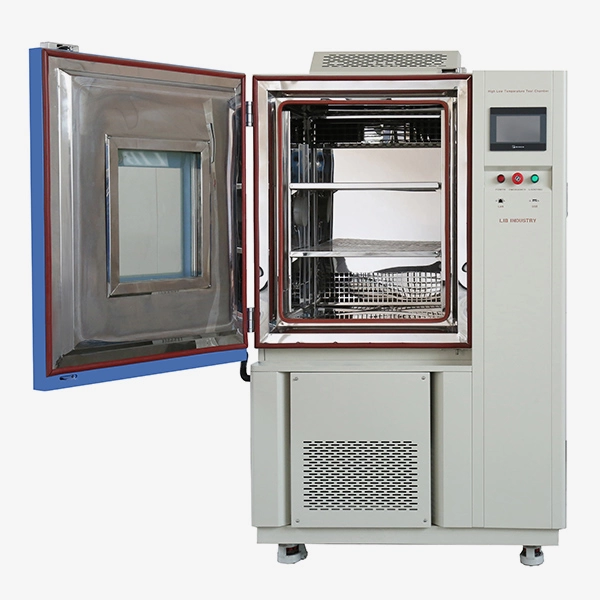
A precision Temperature Humidity Test Chamber allows engineers to control temperature and relative humidity independently within a defined workspace.
This controlled environment makes it possible to evaluate how automotive electronics respond to sustained humidity, high-temperature moisture exposure, and programmed climatic transitions without the unpredictability of natural outdoor conditions.
For automotive R&D laboratories, repeatability is particularly important. Testing the same ECU or sensor design under consistent environmental profiles allows engineers to compare design revisions, materials, coatings, connectors, and packaging approaches using a controlled baseline.
LIB Industry temperature humidity chambers can be considered for this type of environmental simulation where repeatable temperature and humidity control is required during component validation.
Automotive humidity testing generally involves two broad environmental approaches.
1. Steady-State Testing
Components remain under a defined temperature and humidity condition for an extended period.
A commonly referenced example is prolonged exposure to high temperature and high relative humidity. This approach is useful for evaluating:
Moisture penetration
Packaging resistance
PCB insulation performance
Coating durability
Material aging
Long-term electronic stability
2. Cyclic Damp Heat Testing
Temperature and humidity conditions change according to a programmed sequence.
Repeated heating, humidification, cooling, condensation, and drying can reveal weaknesses that remain hidden under static conditions. Cyclic profiles are particularly useful for studying:
Coating defects
Seal degradation
Moisture accumulation
Material expansion and contraction
Connector performance
Repeated condensation effects
For laboratories that perform several automotive qualification procedures, a programmable chamber generally provides greater flexibility than a basic fixed-condition system.
Reliable test results depend on accurate environmental measurement.
Humidity monitoring systems may use capacitive sensors, psychrometric measurement methods, or other control technologies depending on equipment design.
The important procurement factors include:
Measurement accuracy
Response time
Long-term sensor stability
Calibration accessibility
Resistance to prolonged high-humidity exposure
Repeatability between test runs
When evaluating equipment from LIB Industry or another environmental test chamber manufacturer, buyers should consider not only the published humidity range but also how the sensing and control system performs throughout extended test programs.
Automotive electronics tested inside a damp heat simulation environment
Automotive electronics qualification may involve standards and procedures such as AEC-Q100, JESD test methods, IEC environmental testing standards, or OEM-specific validation specifications.
Environmental simulation equipment must be capable of reproducing the conditions required by the applicable test method.
Important chamber capabilities can include:
Stable temperature control
Controlled relative humidity
Uniform environmental distribution
Programmable test profiles
Accurate transition control
Reliable data recording
Safety protection
Continuous operation
The correct specification depends on the component being tested and the actual qualification procedure rather than on one universal chamber configuration.
IEC 60068-2-30 includes cyclic damp heat procedures involving controlled changes in temperature and humidity.
For this type of test, environmental equipment must manage both variables through programmed transitions. Temperature changes can directly affect relative humidity and condensation behavior, so coordination between heating, cooling, humidification, and dehumidification systems becomes particularly important.
A programmable controller allows laboratories to create multi-step profiles and reproduce specific environmental sequences consistently.
When configuring equipment for cyclic humidity applications, LIB Industry engineers can evaluate requirements such as temperature range, humidity range, chamber volume, sample loading, and required profile complexity.
Automotive quality systems depend heavily on traceable test records.
Environmental testing equipment should provide suitable recording capabilities so engineers can confirm that the required temperature and humidity profile was maintained throughout the test.
Useful functions may include:
Real-time monitoring
Historical curve display
Temperature and humidity recording
Alarm history
Program status monitoring
Test data export
Remote monitoring options
User access controls
These records help support internal quality reviews, engineering investigations, customer documentation, and qualification reporting.
Selecting the appropriate chamber architecture depends largely on the complexity and diversity of the required test programs.
A Constant Temperature Humidity Chamber is suited to applications where samples remain under relatively stable environmental conditions for extended periods.
Typical Applications
Long-duration humidity exposure
Material aging
PCB moisture resistance
Steady-state bias testing
Packaging evaluation
Basic component durability testing
Key Procurement Considerations
For these applications, buyers should pay particular attention to long-duration operational stability, humidity control, energy consumption, sensor drift, and maintenance requirements.
A chamber used continuously for hundreds or thousands of hours must remain stable without frequent intervention.
A Programmable Temperature Humidity Chamber supports multi-stage environmental profiles involving changes in temperature, humidity, dwell time, and repeated cycling.
Typical Applications
Cyclic damp heat testing
Automotive qualification programs
Custom OEM test profiles
Sensor validation
ECU reliability testing
Electronic module development
Simulated day/night environmental cycles
Key Procurement Considerations
Laboratories should evaluate:
Number of programmable steps
Cycle repetition capability
Controller interface
Temperature transition performance
Humidity recovery
Data recording
Profile editing
Remote operation functions
For companies performing multiple validation programs, programmable equipment generally offers greater adaptability as test requirements evolve.
| Feature | Constant Chamber | Programmable Chamber |
|---|---|---|
| Primary Application | Long-duration stable environments | Multi-step environmental cycles |
| Test Flexibility | Suitable for fixed conditions | Suitable for changing test profiles |
| Programming Requirement | Relatively simple | More advanced |
| Typical Automotive Use | Material and moisture resistance | ECU, sensor, PCB and cyclic qualification |
| Main Evaluation Focus | Stability and continuous operation | Programming, ramp control and repeatability |
Many modern automotive electronic assemblies are tested while powered.
ECUs, control boards, power modules, and other active components generate heat inside the chamber. This heat becomes an additional thermal load that the environmental system must compensate for continuously.
If the refrigeration capacity is insufficient, the test specimen may increase the internal workspace temperature. This can alter both temperature and relative humidity conditions and make it difficult to maintain the required environmental set point.
Before selecting a chamber, laboratories should therefore estimate:
Number of powered samples
Individual sample heat dissipation
Total electrical load
Required chamber temperature
Required humidity
Test duration
Internal fixture contribution
Cable-port requirements
Powered testing requirements should be communicated clearly during equipment configuration.
Condensation must occur only when required by the test procedure.
Uncontrolled water droplets forming on internal chamber surfaces can create test conditions that differ from the intended environmental profile. Dripping water directly onto an ECU or PCB, for example, may create an unrealistic localized failure mechanism.
Chamber construction and airflow therefore matter.
Buyers should review:
Workspace airflow
Ceiling and wall structure
Drainage design
Condensation management
Sample positioning
Rack arrangement
Internal circulation
These details become especially important when sensitive electronics are tested for long periods.
Humidity generation systems generally require suitable water quality.
Minerals and contaminants in untreated water can accumulate on heaters, water circuits, sensors, and other humidification components. Over time, these deposits may affect system efficiency and increase maintenance requirements.
Depending on the chamber configuration, deionized or appropriately treated water may be recommended.
Before installation, laboratories should confirm the water specification required by the equipment supplier and ensure that the facility can provide a stable supply.
Environmental testing equipment must maintain measurement consistency over its service life.
Temperature and humidity sensors may gradually drift, especially after prolonged exposure to demanding operating conditions. Regular calibration and preventive maintenance are therefore important for maintaining reliable test data.
Before purchasing a chamber, evaluate:
Calibration procedure
Sensor accessibility
Preventive maintenance intervals
Consumable components
Replacement-part availability
Technical documentation
Troubleshooting support
Service accessibility
LIB Industry provides technical support for environmental test chamber projects and can assist users in understanding equipment operation, routine maintenance, and application requirements throughout the chamber lifecycle.
Automotive electronics reliability cannot be evaluated through temperature range specifications alone.
Damp heat testing places simultaneous demands on humidity control, thermal management, airflow, sensor accuracy, programming, condensation management, and long-duration operational stability.
The correct chamber should therefore be chosen around the actual automotive component and test profile.
For a simple long-duration moisture resistance test, a constant temperature humidity chamber may be sufficient. For ECUs, sensors, PCBs, and electronic modules subjected to multi-stage climatic profiles, programmable temperature humidity equipment provides greater testing flexibility.
Powered samples introduce another important consideration. Their heat output must be included when calculating refrigeration capacity and overall chamber performance.
A well-specified test system allows automotive laboratories to reproduce demanding climatic conditions consistently, identify moisture-related weaknesses earlier, and generate more reliable validation data before components move into vehicle production.
A: A temperature cycling chamber primarily controls changes in temperature and is used to evaluate thermal stress and temperature-related material effects. A temperature humidity chamber adds controlled relative humidity, making it suitable for investigating corrosion, moisture ingress, insulation degradation, coating performance, and other humidity-related failure mechanisms.
A: High-temperature, high-humidity exposure accelerates moisture penetration and humidity-related degradation within electronic materials and packaging. It provides engineers with a controlled method for studying long-term moisture resistance within a shorter laboratory timeframe.
A: A powered ECU generates heat inside the test workspace. This live thermal load must be removed by the refrigeration system. If the chamber does not have sufficient cooling capacity, workspace temperature can rise and relative humidity control may become unstable.
A: Requirements vary according to chamber size and configuration. Industrial systems may require dedicated electrical connections, suitable drainage, treated water, ventilation, and sufficient installation and maintenance space. Utility requirements should be confirmed before the chamber arrives on site.
A: Yes. A programmable temperature humidity chamber can often support multiple test programs for ECUs, sensors, PCBs, connectors, electronic modules, and related automotive components, provided the required environmental ranges, chamber capacity, sample load, and test profiles fall within the equipment specification.
Developing a validation program for ECUs, sensors, PCBs, automotive control modules, or other electronic components? LIB Industry provides temperature humidity test chamber solutions for environmental simulation and reliability testing applications.
Tell us the component you need to test, the required temperature and humidity conditions, whether the samples operate under power, and the standards or test profiles involved. Our technical team can help evaluate the chamber capacity and control configuration required for your application.
Contact LIB Industry to discuss your automotive electronics testing project and request technical information or a quotation.


