
Views: 0 Author: Site Editor Publish Time: 2026-09-07 Origin: Site


Securing long-term commercial viability for photovoltaic (PV) modules requires passing highly stringent environmental stress tests. Specifically, manufacturers must rigidly adhere to Damp Heat (DH) and Humidity Freeze (HF) testing protocols. Failure to identify moisture ingress or thermo-mechanical weaknesses before mass production can lead to serious field failures, warranty claims, reputational damage, and restricted market access.
Evaluating and procuring the right Temperature Humidity Chamber remains a critical capital expenditure for testing laboratories and PV manufacturing facilities. For manufacturers evaluating environmental testing equipment, LIB Industry can be considered when selecting a chamber configuration that matches module dimensions, testing protocols, laboratory space, and production throughput.
This guide outlines standard testing requirements, essential equipment evaluation criteria, and practical implementation considerations. It will help you better understand compliance requirements, equipment sizing, facility preparation, and the key factors involved in selecting a suitable PV testing chamber.
Standard Compliance: Damp Heat testing at 85°C/85% RH for 1000 hours and Humidity Freeze testing are important parts of PV module reliability evaluation under standards such as IEC 61215.
Equipment Sizing: Testing requirements can range from coupon-level R&D to complete PV module validation, requiring benchtop, standard industrial, or walk-in chamber configurations.
Evaluation Focus: Procurement should prioritize continuous operational reliability, accurate temperature and humidity control, controlled ramp rates, and workspace uniformity.
Risk Mitigation: Power supply, cooling, water quality, drainage, safety systems, and data logging should all be considered before installation.
Commercial success in the solar industry depends on more than high initial cell efficiency. Manufacturers must demonstrate that modules can withstand years of exposure to changing temperature, humidity, moisture, and other environmental stresses. Controlled laboratory testing therefore forms an important part of PV module reliability verification and product qualification.
Passing DH and HF tests is an important requirement under major photovoltaic testing frameworks. Standards such as IEC 61215, IEC 61730, and ASTM E1171 provide environmental testing guidelines for evaluating module durability and safety.
For manufacturers targeting international markets, maintaining standardized environmental testing capability helps support certification programs, customer qualification procedures, and internal quality control.
Field failures can create substantial costs for PV manufacturers. Laboratory environmental testing accelerates exposure to challenging temperature and humidity conditions so that potential weaknesses can be identified before large-scale deployment.
Common failure modes include:
Module delamination
Encapsulant degradation
EVA yellowing
Gridline corrosion
Junction box adhesion problems
Seal degradation
Moisture ingress
Identifying these weaknesses during product development and qualification can reduce the risk of warranty claims and costly field failures.
Large-scale solar projects often involve developers, investors, insurers, EPC contractors, and financial institutions. Reliable test data gives these stakeholders additional information when evaluating the long-term performance of photovoltaic modules.
Consistent environmental testing and transparent quality documentation can therefore contribute to product qualification, reliability verification, and overall project bankability.
Understanding the different mechanisms behind DH and HF testing is important when selecting environmental testing equipment. Each protocol targets different vulnerabilities within the photovoltaic module structure.
Damp Heat testing evaluates how effectively a module resists prolonged exposure to elevated temperature and humidity.
Parameters: Modules are typically exposed to 85°C and 85% relative humidity for at least 1000 hours, equal to approximately 42 days of continuous testing.
Failure Modes Targeted: Moisture penetration, edge-seal degradation, junction box adhesion issues, encapsulant degradation, and electrochemical corrosion.
Because the test continues for more than 40 days, uninterrupted chamber operation becomes particularly important. Equipment downtime during a long-duration test may lead to lost testing time and repeated test cycles.
Humidity Freeze testing evaluates how PV modules respond to repeated transitions between high temperature, high humidity, and sub-zero conditions.
Parameters: Modules cycle between approximately 85°C/85% RH and temperatures that may reach -40°C, depending on the applicable test procedure.
Failure Modes Targeted: Cell micro-cracking, structural delamination, material expansion and contraction, seal damage, and mechanical stress caused by moisture freezing within the module structure.
DH and HF testing place different demands on environmental testing equipment.
Damp Heat testing requires stable temperature and humidity control over extended periods, while Humidity Freeze testing requires accurate transitions between hot, humid, and freezing conditions.
When evaluating a supplier such as LIB Industry, PV manufacturers should therefore consider not only the chamber's nominal temperature and humidity ranges, but also its long-duration stability, refrigeration capacity, control accuracy, airflow design, and performance under actual module loads.
Summary Comparison of DH and HF Protocols
| Protocol | Primary Conditions | Duration / Cycle | Targeted Vulnerabilities |
|---|---|---|---|
| Damp Heat (DH) | 85°C / 85% RH | 1000+ continuous hours | Seal degradation, corrosion, EVA degradation |
| Humidity Freeze (HF) | 85°C/85% RH to -40°C | Typically repeated cycles | Mechanical stress, micro-cracking, delamination |
Temperature Humidity Chamber for Photovoltaic Module Testing
Choosing the appropriate equipment size directly affects testing efficiency, usable chamber capacity, facility layout, and operating costs. Chamber selection should therefore be based on the dimensions of the test samples, required batch capacity, testing frequency, and applicable environmental test protocols.
LIB Industry can be referenced during the equipment selection stage to determine which chamber configuration is more suitable for component testing, complete PV module testing, or larger-volume environmental qualification projects.
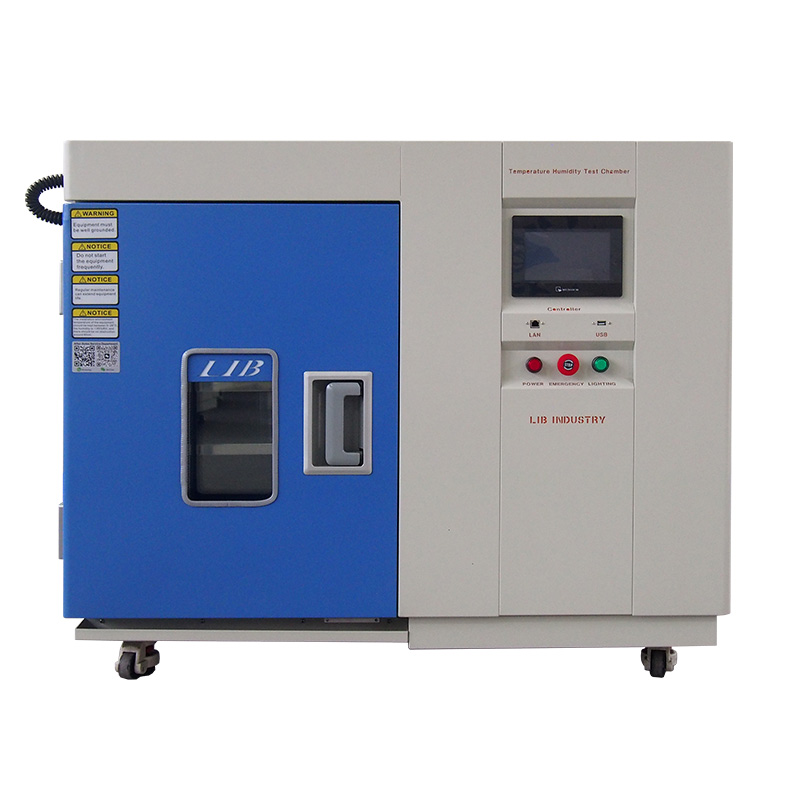
Smaller testing volumes generally require compact equipment. A Benchtop Temperature Humidity Chamber can be suitable for early-stage research and component-level testing.
Best For: R&D laboratories, raw material testing, photovoltaic cells, components, and coupon-scale samples.
Advantages: Compact footprint, lower space requirements, and easier laboratory installation.
Limitations: Restricted internal volume generally prevents testing complete commercial PV modules.
Benchtop chambers are therefore more appropriate for material screening and early product development rather than complete module qualification.
Once testing progresses from individual materials or cells to complete products, larger equipment is required.
An Industrial Temperature Humidity Chamber can support routine environmental testing in manufacturing and quality-control environments.
Best For: Standard batch testing, production QA/QC, product validation, and complete PV module testing.
Advantages: Good balance between usable capacity and facility footprint.
Considerations: May require dedicated floor space, industrial electrical connections, water supply, drainage, and ventilation.
When discussing a configuration with LIB Industry, buyers should provide actual module dimensions, quantity per test batch, required temperature range, humidity range, and applicable test standards. These parameters help determine a more appropriate chamber volume and system capacity.
High-volume PV manufacturing environments may require significantly greater chamber capacity.
A Walk In Temperature Humidity Chamber can be considered when multiple modules, oversized modules, racks, or larger test assemblies must be evaluated simultaneously.
Best For: High-throughput manufacturing facilities, large PV modules, multiple-module testing, and high-capacity reliability laboratories.
Advantages: Larger usable workspace and greater batch testing capacity.
Considerations: Higher capital investment, larger facility footprint, increased utility requirements, and more complex installation planning.
For walk-in systems, buyers should evaluate the complete installation project rather than only the chamber itself. Power supply, drainage, water treatment, ventilation, installation access, floor loading, and maintenance clearance should all be included in the planning process.
Purchasing environmental testing equipment requires more than comparing maximum temperature, minimum temperature, humidity range, and chamber volume.
PV testing can involve prolonged operation, high thermal loads, large glass modules, demanding temperature transitions, and strict data-recording requirements. The following factors should therefore be examined carefully during procurement.
A standard Damp Heat test may require more than 1000 hours of continuous exposure. Chamber reliability is therefore particularly important.
Equipment should be evaluated for:
Refrigeration system reliability
Humidity generation stability
Temperature control stability
Long-duration continuous operation
Controller reliability
Safety protection
Alarm systems
Maintenance accessibility
When comparing environmental chamber suppliers, including LIB Industry, buyers should specifically discuss the intended duration of continuous PV testing rather than evaluating equipment only under short laboratory test conditions.
Spatial uniformity directly affects the consistency of test conditions.
If airflow, temperature, or humidity distribution is uneven, modules positioned at different locations inside the chamber may experience different environmental conditions. Cold spots can also contribute to unwanted condensation.
Buyers should therefore review:
Temperature uniformity
Humidity uniformity
Air circulation design
Rack arrangement
Sample spacing
Sensor positioning
The performance of the chamber should ideally be considered under realistic loading conditions rather than only when the workspace is empty.
Humidity Freeze testing requires the chamber to transition accurately between high-temperature/high-humidity conditions and low temperatures.
Important considerations include:
Heating rate
Cooling rate
Temperature recovery
Overshoot control
Refrigeration capacity
PID control performance
Actual ramp performance with loaded PV modules
The thermal mass of photovoltaic modules can significantly influence the chamber's real transition rate.
PV modules contain glass, aluminum frames, polymers, cells, and other materials that create considerable thermal mass.
For this reason, chamber sizing should not be based only on empty-space performance.
Before requesting a quotation from LIB Industry or another environmental chamber supplier, buyers should prepare information such as:
Module dimensions
Module weight
Number of modules per batch
Rack configuration
Starting temperature
Target temperature
Required ramp rate
Humidity conditions
Test duration
Providing these details allows the chamber configuration to be evaluated against the actual thermal load.
Common Pitfalls in Equipment Evaluation
| Evaluation Area | Common Mistake | Recommended Best Practice |
|---|---|---|
| Uniformity | Ignoring airflow around stacked modules | Evaluate airflow and uniformity with realistic rack loading |
| Thermal Mass | Sizing equipment based only on an empty chamber | Calculate capacity based on actual PV module loading |
| Reliability | Focusing only on maximum specifications | Assess long-duration operating stability |
| Installation | Ignoring utilities until equipment arrives | Confirm power, water, drainage, and space before ordering |
| Data Logging | Treating recording functions as optional | Confirm test data export and traceability requirements |
Successful PV environmental testing requires more than choosing suitable equipment. The facility must also provide the utilities, infrastructure, and operating conditions required by the chamber.
Large environmental chambers may require significant electrical capacity. Industrial and walk-in systems can require three-phase power depending on chamber size and refrigeration configuration.
Humidity systems may also require treated or demineralized water.
Poor water quality can lead to mineral deposits on heaters, piping, and humidity-related components, increasing maintenance requirements and potentially affecting measurement accuracy.
Facility planning should therefore consider:
Electrical supply
Water quality
Water supply
Drainage
Ventilation
Installation access
Floor space
Equipment maintenance clearance
Ambient operating conditions
For larger LIB Industry chamber projects, providing facility information during the initial technical discussion can help avoid configuration or installation problems later in the procurement process.
Environmental testing programs require reliable records of test conditions.
Control and data acquisition systems should provide suitable temperature and humidity monitoring throughout the test period.
Depending on internal QA procedures and certification requirements, manufacturers may need:
Continuous temperature records
Continuous humidity records
Historical trend graphs
Alarm records
Test program records
Data export functions
Traceable test documentation
These capabilities should be confirmed before final equipment selection.
Long-duration testing reduces the opportunities available for routine maintenance.
A chamber operating a 1000-hour Damp Heat test cannot simply be stopped frequently for maintenance without affecting testing efficiency.
Before purchasing equipment, buyers should therefore evaluate:
Sensor calibration procedures
Calibration access
Preventive maintenance requirements
Replacement component availability
Service support
Troubleshooting procedures
Routine inspection intervals
Easy access to sensors and major service components can reduce maintenance downtime over the equipment lifecycle.
Reliable Damp Heat and Humidity Freeze testing plays an important role in PV module reliability verification, product qualification, and international market development.
The correct environmental chamber should be selected according to actual module dimensions, thermal load, test protocols, batch capacity, required ramp rates, laboratory infrastructure, and long-term testing requirements.
Manufacturers should avoid choosing a chamber based solely on internal volume or headline temperature specifications. Continuous operating stability, temperature and humidity uniformity, refrigeration capacity, loaded ramp performance, data recording, safety protection, and service accessibility are equally important.
For PV manufacturers, testing laboratories, and quality-control departments evaluating new environmental testing equipment, LIB Industry can be included in the equipment selection process. Providing detailed test parameters and sample information at the beginning of the project helps engineers evaluate a chamber configuration that better matches the intended application.
A: The IEC 61215 Damp Heat test typically requires at least 1000 hours of continuous exposure, equal to approximately 42 days. Some manufacturers may conduct longer internal reliability tests depending on their own product validation requirements.
A: Yes, provided that the chamber is designed with the required temperature, humidity, refrigeration, and cycling capabilities. For Humidity Freeze testing in particular, buyers should confirm low-temperature performance and thermal transition capability under actual module loading.
A: Untreated water can cause mineral scale buildup in humidity generation components, heaters, piping, and sensors. Using appropriate treated or demineralized water can reduce deposits, improve system stability, and lower maintenance requirements.
A: Prepare the PV module dimensions, module weight, number of samples per batch, required temperature and humidity range, test duration, target ramp rates, applicable standards, and available installation space. These details allow the supplier to evaluate the chamber configuration more accurately.
A: The decision primarily depends on module dimensions, batch quantity, testing throughput, laboratory space, and production volume. Standard chambers are generally suitable for routine module testing, while walk-in chambers are more appropriate when multiple large modules or higher-volume batches must be tested simultaneously.
Planning a Damp Heat, Humidity Freeze, or other photovoltaic environmental reliability testing project? LIB Industry can help you evaluate a suitable Temperature Humidity Chamber based on your PV module dimensions, sample quantity, temperature and humidity requirements, test duration, ramp rates, and laboratory conditions.
Send us your testing requirements and project details. Our team can discuss the appropriate chamber configuration for your application and provide further technical and quotation information.
Contact LIB Industry today to discuss your PV module testing requirements and request a customized environmental chamber solution.


