


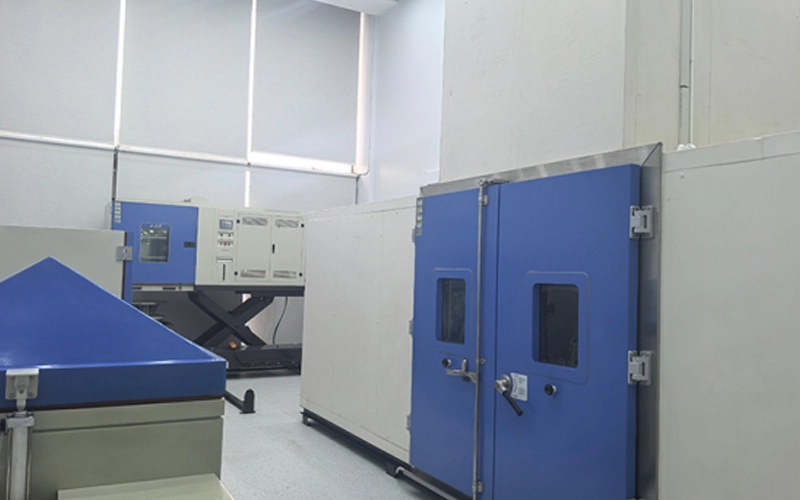
 establishing a MIL-STD-810G compliant testing laboratory. During the visit, LIB engineers provided on-site guidance for the installation and commissioning of environmental test chambers, while also delivering comprehensive training to ensure operators could effectively manage and operate the equipment.
The proposed configuration included:
Vibration Test Chamber THV-1000 for mechanical stress testing
Temperature and Humidity Chamber TH-100B for climatic simulation
Salt Spray Chamber SC-020 for corrosion testing
MIL-STD-810G Dust and Sand Test Chamber DIM-1000 for airborne particle exposure
MIL-STD-810G Rain Test Chamber RIM-1000 for wind-driven rain testing
In addition to equipment positioning, the LIB team also planned the laboratory's water circulation system, drainage layout, and electrical supply, ensuring that all chambers could operate safely and efficiently in long-term testing programs.
After several rounds of technical discussions between both teams, the final laboratory design was confirmed. The five chambers were then carefully packaged and shipped to the customer's facility.
Once the equipment arrived, LIB engineers carried out systematic installation, calibration, and commissioning of each chamber. During the debugging stage, engineers explained every operational step to the client’s technicians—from controller programming and parameter configuration to daily maintenance and safety procedures. Particular attention was given to test parameter settings defined by MIL-STD-810G Method 506.5 (Rain) and Method 510.5 (Sand and Dust).
The training sessions included:
Chamber control and program configuration
Environmental parameter calibration
Safety operation procedures
Maintenance and troubleshooting guidance
This hands-on technical training allowed laboratory operators to fully understand how to run complex environmental test cycles with confidence.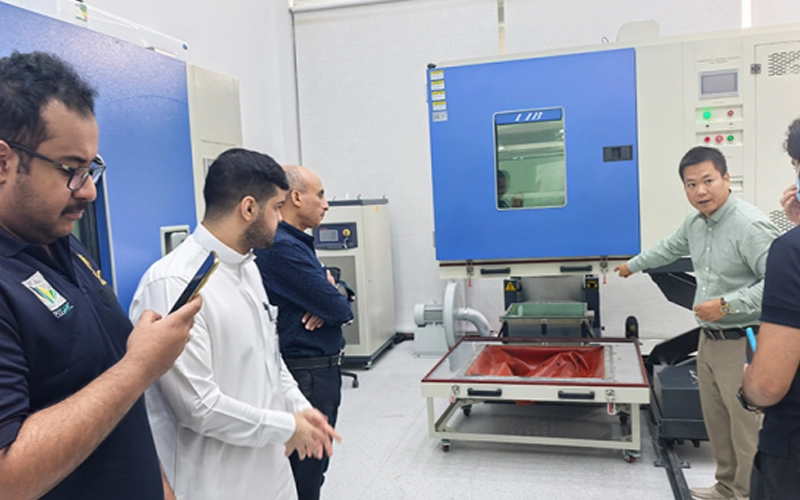
The customer highly praised LIB's professionalism and technical support throughout the installation process. According to the laboratory management team, LIB's on-site guidance played a critical role in ensuring the smooth commissioning and efficient operation of the new MIL-STD-810G laboratory.
The project not only enabled the client to perform advanced environmental testing for their products, but also strengthened the long-term partnership between LIB and international customers in the Middle East region.
Advantages of the MIL-STD-810G Rain Test Chamber
The MIL-STD-810G Rain Test Chamber is designed to simulate realistic rainfall conditions, including wind-driven rain and pressurized water exposure. These tests help evaluate whether equipment can maintain functionality after severe weather conditions.
|
|
| MIL-STD-810G Rain Test Chamber | MIL-STD-810G Dust and Sand Test Chamber |


|
|
| Workroom | Observation window with wiper |
|
|
| Built-in light | Turntable |
|
|
| Built-in power supply | Centrifugal fan |


1. Realistic Wind-Driven Rain Simulation
The chamber can generate wind speeds up to 18 m/s while producing rainfall rates above 1.7 mm/min, accurately replicating storm conditions defined in MIL-STD-810G Method 506.5.
2. Wide Droplet Size Range
Water droplet sizes range from 0.5 mm to 4.5 mm, closely matching natural rainfall characteristics. This ensures reliable evaluation of sealing structures and enclosure protection.
3. Uniform Water Distribution System
A multi-nozzle spray system with pressure up to 276 kPa provides consistent rainfall coverage across the test specimen, preventing uneven exposure during testing.
4. Rotating Test Platform for Complete Coverage
The integrated turntable supports loads up to 100 kg and rotates at 1–7 rpm, ensuring all sides of the device experience uniform rainfall during the test cycle.
5. Durable Industrial Construction
The workroom uses SUS304 stainless steel, while the exterior is made of A3 steel with a protective coating, ensuring long-term durability in high-humidity conditions.
| Name | MIL STD 810h Rain Tester |
|
Model | RIM-0120 | |
Overall Dimension | 2580*6400*4900 mm D*W*H | |
The load Turntable | 100kg | |
The diameter of Turntable | 800mm | |
Drip tray size | 1600*1000mm , height can be adjustable | |
Air speed | ≥ 18m/s | |
Rainfall rate | ≥ 1.7 mm/min | |
Droplet size | 0.5 mm ~ 4.5 mm | |
Turntable speed | 1-7 r/min, adjustable | |
Volume of water | ≥280L/m2/h | |
Nozzle pressure | 276kpa | |
Rainfall rate | 20.8L/min | |
Water supply system | Storage water tank; Booster pump; | |
Automatic water supply; Water purification system; | ||
Cooling system | Mechanical compression refrigeration system | |
Controller | Programmable color LCD touch screen controller | |
Build-in Water Tank(mm) | 710*1130*1400 mm | |
Door Lock | Electromagnetic lock | |
Exterior Material | A3 Steel Plate with protective coating | |
Interior Material | SUS304 stainless steel |

Advantages of the MIL-STD-810G Dust and Sand Test Chamber
The MIL-STD-810G Dust and Sand Test Chamber is engineered to reproduce desert and airborne particulate environments according to MIL-STD-810G Method 510.5.
Model | DIM-1000 |
MIL-STD-810G Dust and Sand Test Chamber |
Overall Dimension | 2800*3500*2000mm D*W*H | |
Interior Volume | 1000L | |
Blowing Dust | ||
Air velocity | 1.5 -8.9m/s | |
Concentration of dust | 10.7±7g/ m³ | |
Dust particles | < 150μm | |
Blowing sand | ||
Air velocity | 18.0 -29.0m/s | |
Concentration of sand | 0.18+0.2g/m³; 1.1+0.3g/m³; 2.2+0.5g/m³ | |
Sand particles | 149μm - 600μm, 600μm - 850μm | |
Controller | Programmable color LCD touch screen controller | |
Door Lock | Electromagnetic lock | |
Testing Platform Diameter | 600mm | |
Testing Platform Speed | 1-7 r.p.m | |
Dust Detector | Integrated dust detector | |
Exterior Material | A3 Steel Plate with protective coating | |
Interior Material | SUS304 stainless steel | |
Maximum Noise | 65 dBA |

1. Dual Sand and Dust Simulation Modes
The chamber supports both blowing dust tests and blowing sand tests, enabling comprehensive evaluation of equipment performance under different particle conditions.
2. Adjustable Airflow for Realistic Conditions
Air velocity ranges from 1.5–8.9 m/s for dust testing and 18–29 m/s for sand testing, allowing engineers to replicate various environmental scenarios from light dust storms to severe desert winds.
3. Controlled Particle Size Distribution
Dust particles smaller than 150 μm and sand particles between 149 μm and 850 μm ensure accurate simulation of real airborne particles.
4. Stable Dust Concentration Control
Dust concentration is maintained at 10.7 ± 7 g/m³, creating a consistent test environment for evaluating sealing structures and sensor reliability.
5. Integrated Dust Monitoring and Safety System
An internal dust detector continuously monitors particle levels while the chamber maintains noise levels below 65 dBA, ensuring both accurate testing and operator safety.
Contact LIB Industry to learn how MIL-STD-810G Rain and Dust Test Chambers can support your environmental testing laboratory and improve the reliability of your products.


