Views: 0 Author: LIB Team Publish Time: 2026-09-18 Origin: Site


A Xenon Test Chamber reproduces the full 280–800 nm solar spectrum, including ultraviolet, visible, and infrared radiation, making it suitable for evaluating colorfastness, fading, gloss loss, and comprehensive material degradation. In contrast, UV fluorescent testing focuses on narrow short-wave ultraviolet bands to accelerate specific polymer failures such as cracking, crazing, and strength loss.
For automotive plastics, neither method universally replaces the other. Chamber selection should be based on the target degradation mechanism and the exact OEM or international testing standard. LIB Industry provides both xenon and UV weathering solutions for automotive, plastic, coating, and polymer durability testing.
Full-Spectrum Simulation: Xenon arc lamps reproduce sunlight across approximately 280–800 nm, while fluorescent UV systems primarily target short-wave ultraviolet radiation.
Different Degradation Targets: Xenon testing is better suited to comprehensive fading and weathering evaluation, while UV fluorescent testing is highly effective for accelerated polymer degradation studies.
Different Moisture Methods: Xenon chambers combine water spray and humidity control, while UV chambers commonly use condensation cycles.
Automotive Standards: Standards such as SAE J2527 and SAE J2412 require xenon arc exposure because they depend on broader solar-spectrum simulation.
Application-Based Selection: The correct chamber depends on the component, material, degradation mode, and required testing standard.
Automotive plastics are exposed to intense environmental stress throughout the service life of a vehicle. Exterior bumpers, grilles, mirror housings, and trim components face sunlight, heat, rain, humidity, and temperature fluctuations. Interior dashboards, door panels, consoles, and decorative plastics experience prolonged solar radiation and high cabin temperatures.
These conditions gradually affect both structural and visual properties. Plastics may fade, yellow, lose gloss, become brittle, crack, or experience changes in tensile performance.
Manufacturers therefore use accelerated automotive plastic weathering to reproduce important environmental stresses under controlled laboratory conditions.
Two of the most widely used methods are xenon arc testing and UV fluorescent testing.
Both accelerate material degradation, but they do so in different ways.
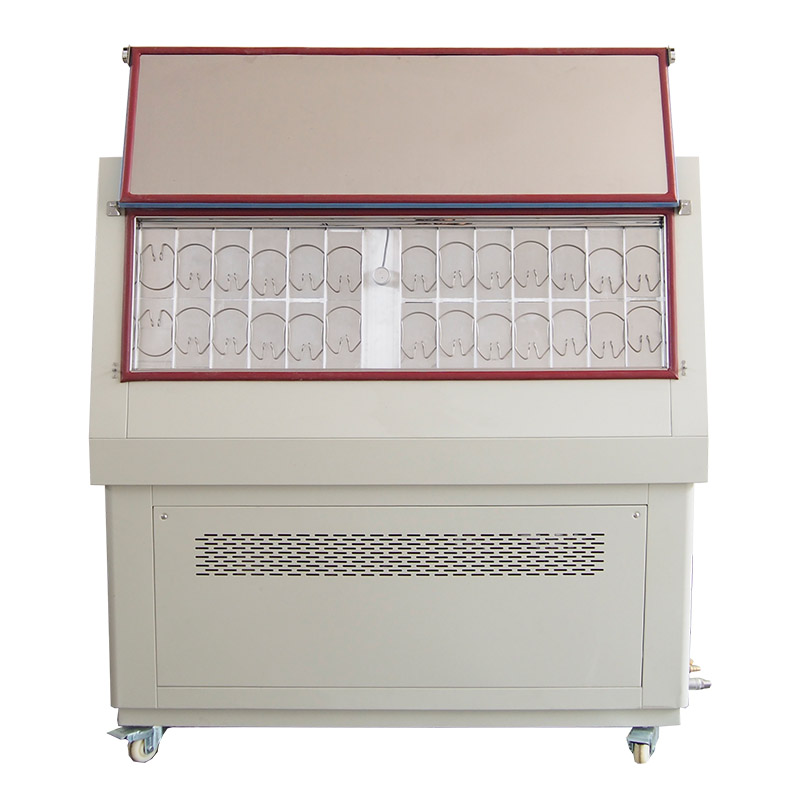
UV fluorescent testing uses lamps that emit controlled bands of ultraviolet radiation. This approach is particularly effective for studying UV-driven polymer degradation, including cracking, embrittlement, crazing, and changes in mechanical strength.
A xenon test chamber, however, reproduces a broader solar spectrum. By combining ultraviolet, visible, and infrared radiation, xenon testing can generate both photochemical and thermal effects that are closer to complete outdoor sunlight exposure.
This makes xenon testing particularly important when manufacturers need to evaluate changes in:
Color.
Gloss.
Surface appearance.
Yellowing.
Pigment stability.
Thermal aging.
Combined weathering durability.
For automotive material laboratories, understanding this distinction is essential before selecting testing equipment.
The most important difference between xenon and fluorescent UV technology is the spectrum generated by the light source.
Fluorescent UV lamps are designed to emit energy within selected ultraviolet wavelengths.
Common configurations include:
UVA-340 lamps.
UVB-313 lamps.
These lamps do not significantly reproduce visible or infrared portions of natural sunlight.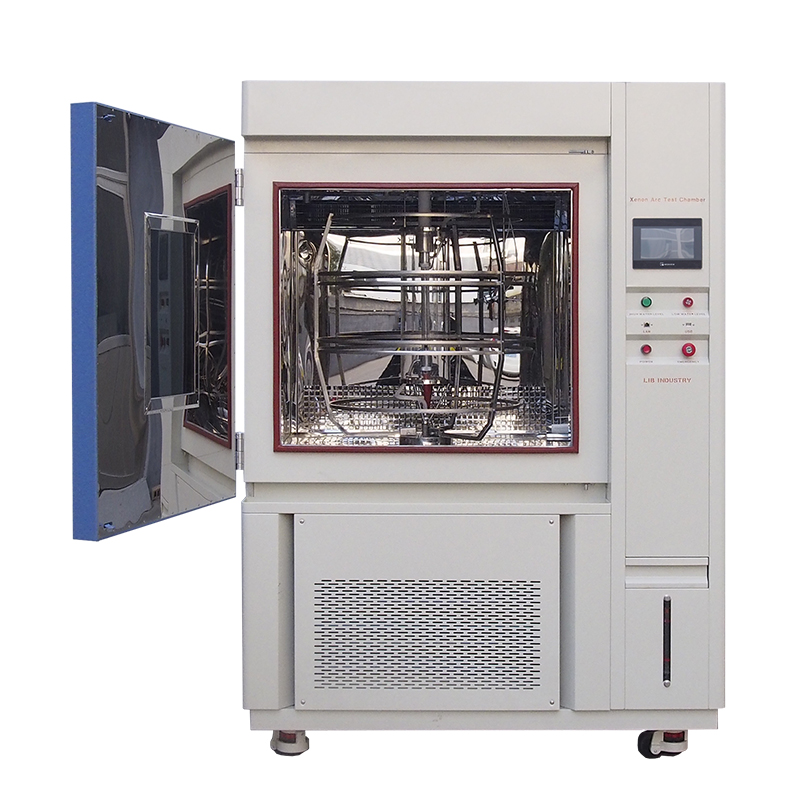
This narrow spectral output makes UV chambers highly effective for aggressive evaluation of ultraviolet-induced degradation. However, it also means they are less suitable when the objective is to reproduce the broader aesthetic changes caused by complete solar exposure.
A xenon arc lamp produces a much wider spectrum.
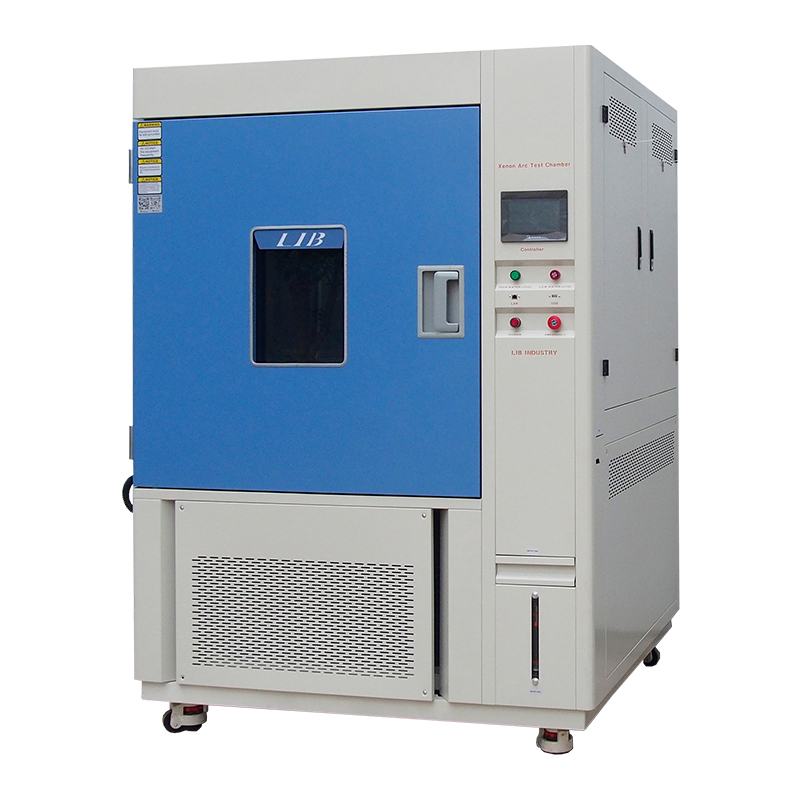
The LIB Industry XL-S-750 Xenon Test Chamber uses a 4500 W water-cooled xenon arc lamp designed to reproduce radiation across approximately 280–800 nm.
This range covers three important spectral regions:
Ultraviolet Radiation (280–400 nm): Drives photochemical degradation and polymer chain breakdown.
Visible Light (400–700 nm): Strongly influences pigments, dyes, fading, and color stability.
Infrared Radiation (700–800 nm): Contributes thermal energy and increases specimen surface temperature.
This broader spectral exposure is particularly important for automotive components where visual appearance matters as much as mechanical durability.
For example, a dashboard exposed to sunlight can experience pigment fading while simultaneously reaching high surface temperatures. A bumper or exterior trim component may experience UV degradation, visible-light fading, and thermal cycling at the same time.
The LIB Industry XL-S-750 Xenon Test Chamber is designed to reproduce these combined effects under controlled laboratory conditions.
Light exposure is only one part of automotive weathering.
Moisture and temperature significantly influence material degradation and must also be reproduced during accelerated testing.
A UV Test Chamber commonly simulates moisture through condensation.
A heated water reservoir generates warm vapor that condenses on the specimen surface.
This process reproduces prolonged wetness similar to nighttime dew.
Condensation is highly effective for evaluating:
Moisture penetration.
Coating degradation.
Surface swelling.
Cracking.
Adhesion loss.
Moisture-assisted polymer degradation.
Xenon weathering chambers typically use more complex environmental control.
The LIB Industry XL-S-750 provides:
Black Panel Temperature control from 35–85 °C.
Temperature accuracy of approximately ±2 °C.
Relative humidity control from 50%–98% RH.
Controlled water spray.
Automatic water supply and recycling.
Black Panel Temperature is especially important in automotive testing because dark plastic surfaces can become considerably hotter than ambient air under direct sunlight.
A black dashboard, bumper, or trim panel absorbs radiation and can reach high surface temperatures. BPT measurement therefore provides a more realistic representation of solar heating than chamber air temperature alone.
Water spray can also reproduce events such as rain contacting a heated exterior component.
The combination of radiation, heat, humidity, and water exposure creates a more comprehensive automotive weathering environment.
To support long-duration testing, LIB Industry integrates automatic water supply and recycling into the XL-S-750 configuration, helping laboratories maintain stable test conditions while reducing manual water replenishment.
| LIB Popular Xenon arc and Weathering Test Chamber for Aging tests | ||
Full-Spectrum Sunlight Simulation, |
Fast UV Degradation Testing, |
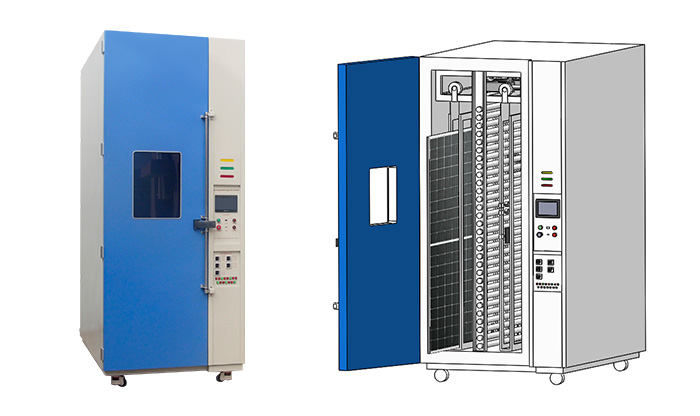
UV Preconditioning Chamber For PV Solar Panel IEC-Compliant PV Preconditioning, |
ASTM B117 Fog Corrosion Salt Spray Test Cabinet ASTM B117 Compliance Testing, Trusted Corrosion Resistance Evaluation |
Cyclic Salt Spray Corrosion Chamber (CCT Chamber) Real-World Corrosion Cycling, |
Temperature and Humidity Test Chamber Precision Environmental Control, Reliable Testing Performance |
Equipment selection in automotive testing should be driven primarily by the required standard.
Different standards define specific light sources, irradiance levels, temperatures, humidity conditions, water cycles, and exposure durations.
For automotive applications, xenon arc testing is required by several important procedures.
SAE J2527 is used for accelerated weathering of automotive exterior materials.
It requires xenon arc exposure because exterior components must be evaluated under a broad representation of sunlight combined with controlled moisture and environmental conditions.
Typical applications include:
Exterior plastics.
Bumpers.
Grilles.
Exterior trim.
Coated plastic parts.
Painted components.
SAE J2412 is widely used for accelerated exposure of automotive interior trim components.
Interior parts may experience extremely high temperatures under sunlight but generally do not require the same water exposure used for exterior testing.
Typical test materials include:
Dashboards.
Door panels.
Interior decorative trim.
Instrument panel components.
Polymer interior surfaces.
The LIB Industry XL-S-750 is designed around requirements associated with several widely used weathering procedures, including:
SAE J2527.
SAE J2412.
ASTM G155.
ISO 11341.
VW PV 1306.
VW PV 3929.
VW PV 3930.
Technical teams should always confirm the exact required cycle before testing because different standards may specify different irradiance levels, temperatures, humidity conditions, spray intervals, and filters.
The following comparison helps clarify when each technology is more appropriate.
| Feature / Capability |
|
|
|---|---|---|
| Light Spectrum | Full spectrum, approximately 280–800 nm | Primarily short-wave UV, commonly UVA-340 or UVB-313 |
| Primary Test Objective | Colorfastness, fading, gloss loss, thermal stress, comprehensive weathering | UV-induced polymer degradation, cracking, crazing, and strength loss |
| Visible Light Simulation | Yes | No |
| Infrared Contribution | Yes | Minimal |
| Moisture Simulation | Water spray and controlled relative humidity | Heated condensation |
| Temperature Monitoring | Black Panel Temperature and chamber control | Chamber/ambient temperature during UV and condensation cycles |
| Automotive Interior Testing | Highly suitable | Limited depending on standard |
| Automotive Exterior Testing | Highly suitable | Useful for specific degradation studies |
| SAE J2527 | Required xenon methodology | Not suitable as a replacement |
| SAE J2412 | Required xenon methodology | Not suitable as a replacement |
| Typical Use | Comprehensive weathering and appearance evaluation | Aggressive UV durability screening |
Neither technology should be considered universally superior.
Instead, they address different testing objectives.
If your primary concern is pigment fading, color change, gloss retention, or complete sunlight simulation, xenon testing is generally more appropriate.
If the goal is to accelerate specific ultraviolet-driven physical degradation, UV fluorescent testing may provide a more focused approach.
Many automotive laboratories use both technologies as complementary testing tools.
LIB Industry provides environmental testing solutions for automotive components, plastics, coatings, polymers, and other materials exposed to outdoor or simulated solar environments.
The XL-S-750 xenon chamber is designed for laboratories requiring repeatable full-spectrum accelerated weathering tests.
Key specifications include:
4500 W water-cooled xenon arc lamp.
Approximate 280–800 nm spectrum.
Black Panel Temperature from 35–85 °C.
±2 °C BPT accuracy.
Relative humidity from 50%–98% RH.
Water spray functionality.
Automatic water supply and recycling.
Rotating specimen rack.
Capacity for up to 42 specimens.
Rotation speed up to approximately 7 rpm.
Support for automotive and international weathering procedures.
The rotating specimen holder improves exposure uniformity by moving samples around the central lamp during testing.
This helps reduce variation caused by specimen position, temperature gradients, and differences in irradiance.
For automotive plastic manufacturers, consistent specimen exposure is important when comparing:
Different polymer formulations.
Pigments.
UV stabilizers.
Coatings.
Surface treatments.
Suppliers.
Production batches.
LIB Industry also provides UV Test Chambers, allowing laboratories to select equipment according to different degradation mechanisms and testing standards.
Before purchasing a xenon or UV chamber, technical and procurement teams should consider several important limitations.
Xenon does not completely replace UV fluorescent testing. The two technologies reproduce different degradation mechanisms and may be used together.
UV testing cannot substitute for standards that explicitly require xenon arc exposure.
No accelerated test perfectly reproduces every outdoor condition.
Standard compliance depends on the programmed test cycle, not only the chamber hardware.
Passing laboratory weathering tests does not automatically guarantee final OEM part approval.
Material results should be interpreted alongside field data whenever possible.
The correct chamber should therefore be selected according to the material, component location, degradation target, and required automotive standard.
Lamp life depends on wattage, irradiance settings, operating cycles, cooling efficiency, and maintenance.
The LIB Industry XL-S-750 uses a 4500 W water-cooled xenon arc lamp with a rated operational lifespan of up to approximately 1600 hours before replacement may be required to maintain stable spectral performance.
Relative humidity helps reproduce moisture conditions experienced by automotive exterior materials.
When combined with water spray and elevated temperatures, controlled RH contributes to swelling, contraction, coating stress, and moisture-assisted degradation.
The XL-S-750 provides a relative humidity range from 50%–98% RH for controlled automotive weathering tests.
Yes, provided the chamber can reproduce the required parameters of each test procedure.
A properly configured xenon chamber may support multiple standards by changing irradiance, filters, temperature settings, humidity levels, and test cycles.
The operator must follow the exact requirements of each standard rather than applying one generic weathering cycle.
Different wavelengths cause different types of degradation.
UV radiation promotes polymer breakdown, visible light influences pigments and fading, and infrared radiation contributes thermal energy.
A complete 280–800 nm exposure therefore provides a broader evaluation of both aesthetic and physical durability.
UV fluorescent testing focuses on aggressive short-wave ultraviolet exposure and is highly effective for studying UV-driven polymer degradation.
Xenon testing reproduces a wider sunlight spectrum and is more suitable for evaluating combined color, appearance, heat, and weathering effects.
The required standard should determine the method.
If the component must comply with SAE J2527 or another xenon-based OEM procedure, a xenon test chamber is required.
For additional ultraviolet durability screening or polymer formulation development, UV fluorescent testing may also be valuable.
Selecting between xenon and UV weathering equipment should begin with four questions:
What automotive component are you testing?
Which degradation mode is most important?
Which OEM or international standard must be followed?
Which environmental parameters must the chamber reproduce?
For exterior trim, bumpers, grilles, and painted plastics where color and full sunlight exposure are important, xenon testing is often the preferred solution.
For targeted UV degradation studies involving cracking, embrittlement, or polymer durability, fluorescent UV testing can provide an efficient and aggressive test environment.
For laboratories requiring both capabilities, using xenon and UV chambers together can provide a more complete understanding of material performance.
If you are unsure whether your automotive plastic should be tested with xenon arc or UV fluorescent equipment, contact LIB Industry for a technical consultation. LIB Industry provides accelerated weathering solutions for different applications, including a Xenon Test Chamberfor full-spectrum sunlight simulation, a Fluorescent UV Test Chamber for accelerated UV degradation testing, and a UV Preconditioning Chamber for PV Solar Panel for photovoltaic module preconditioning.
Share your material type, component application, target OEM standard, specimen dimensions, and required environmental conditions, and the LIB Industry team can help evaluate a suitable weathering chamber configuration for your laboratory or quality-control program.
LIB Industry Technical Team (info@lib-industry.com) — Technical information, testing methods, product specifications, and application guidance for xenon arc testing, accelerated weathering, UV degradation, and material durability evaluation.