


In today's competitive industries, ensuring product reliability under diverse environmental conditions is essential. Environmental chambers, also known as climate test chambers, allow engineers and researchers to simulate extreme temperatures, humidity levels, water exposure, and other environmental factors. By replicating real-world conditions in a controlled laboratory setting, these chambers help companies validate designs, optimize manufacturing processes, and accelerate product development.
In March 2023, a leading American ophthalmology diagnostic equipment company purchased multiple LIB test chambers, including temperature and humidity chambers, water spray chambers, xenon chambers, and salt spray chambers, to expand their laboratory capabilities. The chambers have performed reliably in precision instrument testing, providing consistent and repeatable results. On a visit in March 2024, our team observed the equipment in operation on site, with the customer expressing high satisfaction with the chamber’s performance, efficiency, and ease of use. This demonstrates the tangible value of LIB chambers in supporting high-precision R&D environments.
Introduction
Environmental chambers, also known as climate test chambers, are specialized systems used to reproduce controlled environmental conditions for product testing, material evaluation, scientific research, and reliability verification. These chambers can accurately simulate conditions such as high temperature, low temperature, humidity, thermal cycling, and other environmental stresses to help evaluate product performance under real-world conditions.
Environmental chambers are widely used across industries including electronics, automotive, aerospace, pharmaceuticals, medical equipment, renewable energy, telecommunications, and material engineering. By exposing products to accelerated environmental stress inside the laboratory, manufacturers can detect structural weaknesses, performance instability, sealing problems, and material degradation before products are released to the market.
This type of environmental simulation helps companies improve product reliability, reduce maintenance and warranty costs, and minimize the risk of product failure during actual operation. At the same time, environmental testing supports product optimization, quality assurance, and compliance with international testing standards throughout the development process.
As modern products become more complex and global quality requirements continue to increase, environmental testing has become an essential part of manufacturing and research. Reliable environmental chamber testing allows companies to shorten development cycles, improve product consistency, and strengthen competitiveness in demanding international markets.
Understanding Environmental Chambers
An environmental chamber is an enclosed space where precise control over environmental factors is achieved to replicate real-world conditions. This replication is essential for evaluating the durability, functionality, and resilience of materials, components, and systems across various industries.
Environmental simulation can include:
High and low temperature exposure
Rapid thermal cycling
Controlled humidity conditions
Damp heat aging
Salt spray corrosion
UV and xenon light weathering
Water spray and IP waterproof testing
Altitude and pressure simulation
By recreating environmental stresses in a controlled laboratory setting, organizations can perform accelerated life testing (ALT), environmental stress screening (ESS), and reliability growth testing. This ensures products perform consistently in diverse climates—from tropical humidity to arctic cold, desert heat, and marine corrosion environments.

Key Components of Environmental Chambers
● Control System: A centralized interface for setting and monitoring test parameters.
● Temperature Control System: Comprising heating and cooling units for precise thermal regulation.
● Humidity Control: Utilizes humidifiers and dehumidifiers to manage moisture levels.
● Ventilation System: Maintains air circulation quality within the chamber.
● Data Acquisition System: Records and analyzes test data for evaluation.
How Environmental Chambers Work
Environmental chambers work by enclosing a test sample within a sealed chamber and manipulating environmental parameters according to pre-set conditions. Through a combination of heating and cooling elements, program controllers, and advanced sensors, chambers create and sustain specific temperature. Its software allows users to program complex test cycles, automate data collection, and ensure test reproducibility.
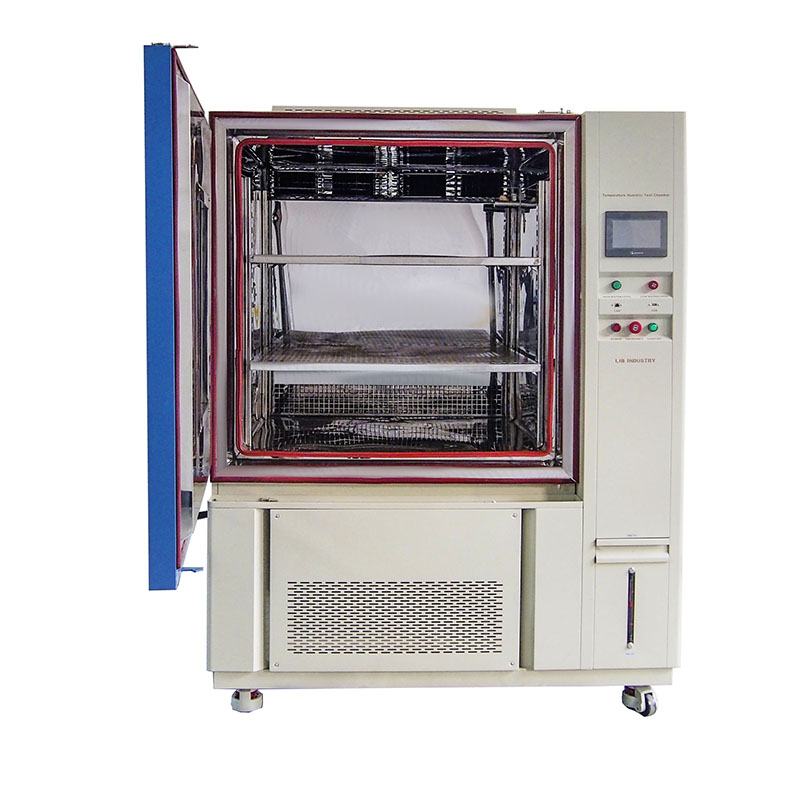  | |||||
Temperature range | -20℃ ~+150 ℃ | ||||
Low type | A: -40℃ B:-70℃ C -86℃ | ||||
Humidity Range | 20%-98%RH | ||||
Temperature deviation | ± 2.0 ℃ | ||||
Heating rate | 3 ℃ / min | ||||
Cooling rate | 1 ℃ / min | ||||
Controller | Programmable color LCD touch screen controller, Multi-language interface, Ethernet , USB | ||||
Refrigerant | R404A, R23 | ||||
Exterior material | Steel Plate with protective coating | ||||
Interior material | SUS304 stainless steel | ||||
Standard configuration | 1 Cable hole (Φ 50) with plug; 2 shelves | ||||
Timing Function | 0.1~999.9 (S,M,H) settable | ||||
Benefits of Environmental Chambers
1.Product Durability Testing: Validates product reliability under extreme conditions.
2.Material Performance Evaluation: Assesses material performance in different environments.
3.Research and Development Acceleration: Enables aging testing and innovation.
4.Compliance and Certification: Helps meet industry standards and regulations.
5.Quality Assurance: Ensures product reliability and customer satisfaction.
Innovations in Environmental Chamber Technology
● Internet of Things (IoT) Integration: Remote monitoring and control of chambers.
● Internet of Things (IoT) Integration: Predictive maintenance and optimized testing protocols.
● Internet of Things (IoT) Integration: Minimizing environmental impact.
● Internet of Things (IoT) Integration: Adaptable for a variety of testing scenarios.
● Internet of Things (IoT) Integration: Improving testing accuracy and reducing variability.
Choosing the Right Environmental Chamber
Selecting the appropriate environmental chamber involves factors such as the testing parameters, sample size, available space, budget, and future testing tools. Consulting with experts and understanding industry-specific requirements is key to making a decision.
|
|
| |
|---|---|---|---|
 |  |  | |
| Name | Small Climatic Test Chamber | Standing Climatic Test Chamber | Walk-In Climatic Test |
| Capacity | TH-50: 800x1050x950 mm TH-80: 900×1100×1000mm | Capacity: 100L; 225L; 500L; 800L; 1000L | >20m³ |
| Throughput | Ideal for small components, sensors, boards | Subassemblies or mid-volume batches | Bulk testing of items or vehicles as a whole |


LIB's benchtop environmental chamber
As an example, LIB's benchtop environmental chamber offers a compact solution ideal for laboratory settings where space is limited. It combines precision control with user-friendly interfaces, providing researchers with a versatile tool for conducting small-scale tests efficiently and accurately.
| Name | Benchtop Chamber |
| |
| Model | TH-50 | TH-80 | |
| Internal dimension (mm) | 320x350x450 | 400x400x500 | |
| Overall dimension (mm) | 800x1050x950 | 900×1100×1000 | |
| Temperature range | -20℃ ~+150 ℃ | ||
| Low type | Ⅰ: -40℃ Ⅱ: -70℃ Ⅲ: -86℃ | ||
| Temperature fluctuations | ± 0.5 ℃ | ||
| Humidity Range | 10%/20%~95% | ||
| Temperature deviation | ± 2.0 ℃ | ||
| Heating rate | 3 ℃ / min | ||
| Cooling rate | 1 ℃ / min | ||
| Temperature Sensor | PTR Platinum Resistance PT100Ω/MV A-class | ||
| Temperature Resolution | ± 0.001 ℃ | ||


The chamber is widely used for testing electronic components, batteries, sensors, plastics, coatings, pharmaceutical samples, and laboratory research materials. Its programmable controller supports multiple test profiles and automatic cycling functions, enabling users to conduct temperature cycling, humidity testing, storage simulation, and accelerated aging tests with minimal manual intervention. Real-time monitoring and data recording functions also help improve test traceability and operational efficiency.
To support long-term laboratory operation, LIB's benchtop environmental chamber adopts durable SUS304 stainless steel interiors, high-quality insulation materials, and reliable refrigeration and humidification systems. The compact structure allows flexible installation in laboratories, research centers, universities, and quality control departments where space optimization is important. Easy-access maintenance design also simplifies routine inspection and cleaning procedures, reducing downtime and operational costs.
In addition to reliable equipment performance, LIB provides technical consultation, customized configurations, remote support, and after-sales service for global customers. The benchtop chamber can be configured according to different international testing standards such as IEC, ASTM, ISO, and MIL-STD requirements, helping laboratories achieve accurate environmental testing while improving product development efficiency and quality assurance capabilities.
Conclusion
Environmental chambers serve as indispensable tools in modern research, development, and quality assurance processes. Their ability to simulate diverse environmental conditions allows for thorough testing and evaluation, contributing to product excellence and scientific advancement. With continuous technological innovations, these chambers are becoming even more flexible, efficient, and environmentally friendly, further enhancing their value across industries.
With ongoing advancements in automation, IoT connectivity, energy efficiency, and precision control, environmental chambers are becoming more intelligent, sustainable, and versatile. As industries continue to demand higher durability standards and faster innovation cycles, environmental simulation technology will remain a cornerstone of product excellence and scientific progress.
For tailored environmental testing solutions and professional consultation, contact LIB Industry today.


