Views: 0 Author: Site Editor Publish Time: 2026-08-04 Origin: Site


A single season of intense summer sun can fade a car dashboard, chalk a coating, or crack a plastic housing beyond recognition. For engineers who need to know this outcome before it happens in the field, months of outdoor waiting is not an option. This article explains what LIB Industry's ISO 4892 Aging Test Light Fastness Xenon Arc Chamber Weatherometer actually does, what standards it must satisfy, how it works, and why one Uzbekistan customer chose five LIB Industry environmental chambers built around this exact technology.
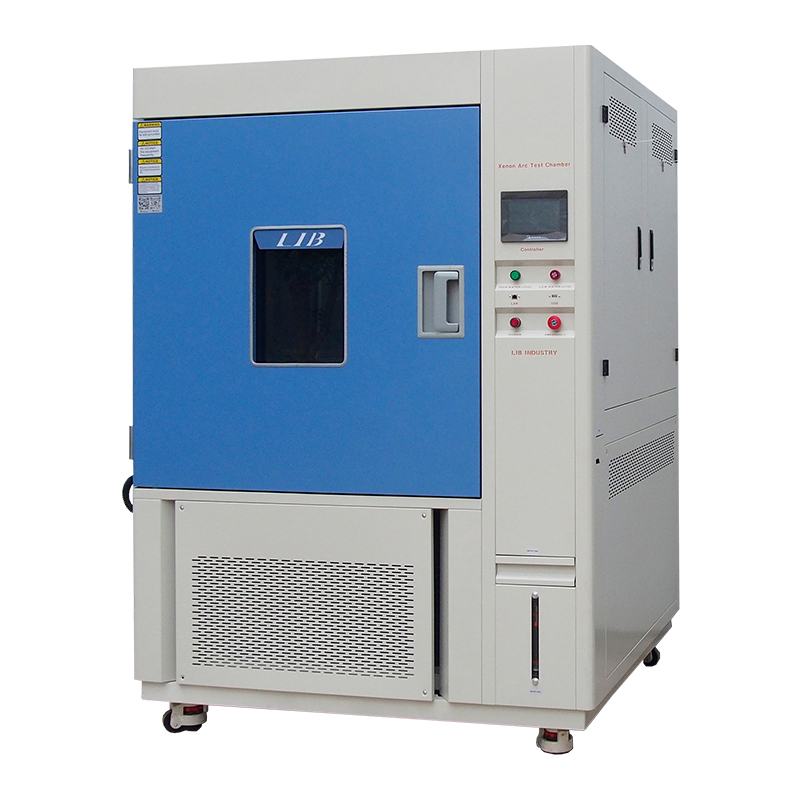
A Full-Spectrum Sunlight Simulator The ISO 4892 Aging Test Light Fastness Xenon Arc Chamber Weatherometer reproduces natural sunlight, heat, humidity, and rain in one enclosed chamber, letting manufacturers compress years of outdoor weathering into weeks of laboratory time. Unlike UV-only fluorescent equipment, its xenon arc source covers 280–800 nm, matching the full solar spectrum rather than just the UV band. This makes it the preferred choice for plastics, coatings, textiles, automotive components, and building materials where color, gloss, and mechanical strength all matter.
Standards Compliance and Working Principle LIB Industry's equipment is built to comply with ISO 4892, ASTM G155, ASTM D6695, ASTM D7869, ISO 11341, and ISO 16474, so results are accepted by labs worldwide. At its core sits a 4500 W water-cooled xenon arc lamp paired with interchangeable optical filters — daylight, window glass, and extended UV — allowing the spectrum to match indoor or outdoor use cases. A PID control system continuously reads irradiance, chamber air temperature, black panel temperature, and humidity, holding each within tight tolerance so results stay repeatable test after test.
Testing Methods in Practice A typical test loads up to 42 specimens onto a rotating rack turning at up to 7 revolutions per minute, guaranteeing every sample receives identical exposure. Irradiance is commonly set at 0.35 W/m²·nm at 340 nm for daylight simulation, or 1.10 W/m²·nm at 420 nm for window-glass simulation, with black panel temperature held between 45 °C and 65 °C and humidity cycling from 50% to 95% RH. Chamber temperature can reach 100 °C ±2 °C, black panel temperature 35–85 °C ±2 °C, and humidity control holds ±5% RH — parameters an operator can program directly through the touchscreen controller for automated, unattended cycles.
An Uzbekistan-based manufacturer recently ordered five environmental test chambers from LIB Industry, with the ISO 4892 Xenon Arc Chamber Weatherometer as the centerpiece for evaluating coating and plastic component durability. After running their own product performance testing on-site, the customer reported strong satisfaction with several concrete advantages.
First, safety compliance stood out. The chamber meets CE, IEC, and CSA safety requirements, and is backed by over-temperature protection, over-current protection, water shortage protection, earth leakage protection, and phase sequence protection — five layers of safeguards working together during long unattended runs. Second, testing precision impressed the team: irradiance control within ±5% and black panel temperature control within ±2 °C gave them confidence that results from different test batches would remain comparable. Third, the price-to-performance ratio made the investment easy to justify across all five units purchased together.
Customization was another deciding factor. LIB Industry provided the rotating specimen rack and cable pass-through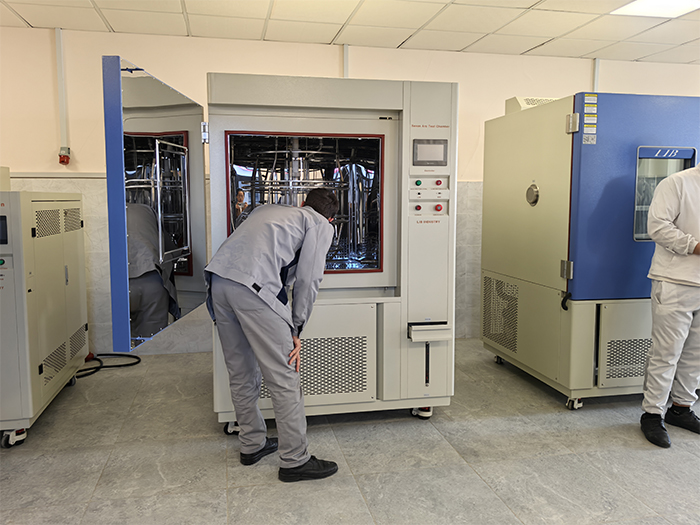 ports as free custom options at no extra charge, tailored to the customer's specific specimen geometry and data-logging needs. Humidity stability throughout each cycle, held within ±5% RH, also reassured the customer that their coated and painted samples would age consistently rather than drift between test runs.
Finally, the after-sales package sealed the decision: a 3-year warranty with lifetime technical support, combined with on-site training for the customer's lab technicians, meant the team could operate the chamber confidently from day one. This human, hands-on approach — rather than just shipping a machine and walking away — is what the Uzbekistan customer specifically praised about working with LIB Industry.
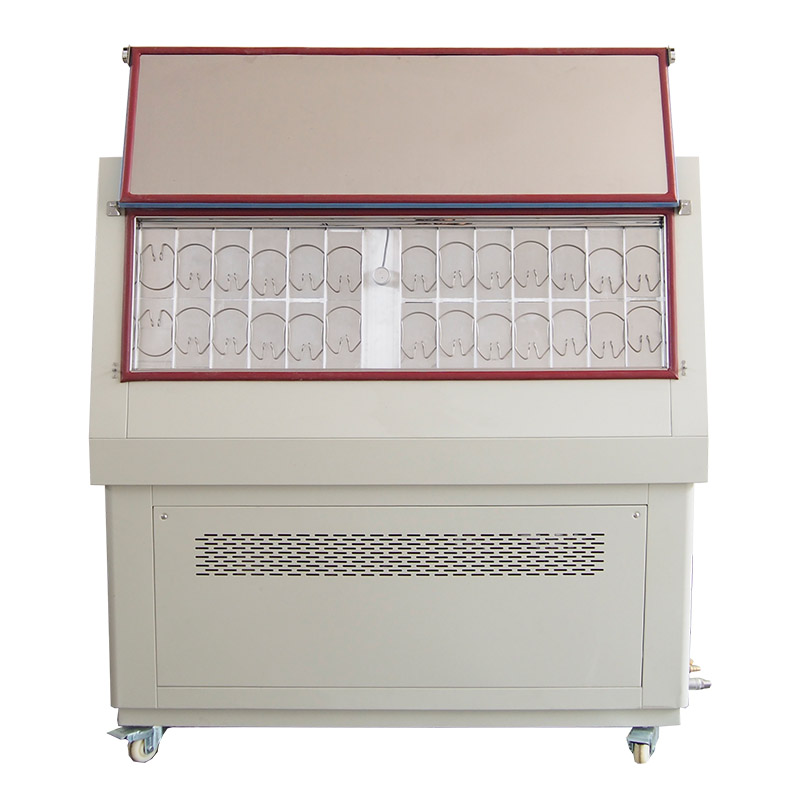
Both machines age materials with light, but they answer different questions. The xenon arc weatherometer reproduces the full solar spectrum, while the UVA 340 fluorescent instrument isolates the short-wavelength UV band that does the most damage to polymers and pigments — so the right choice depends on what your specimens are made of and what failure mode you are chasing.
The xenon arc chamber's 4500 W water-cooled lamp covers 280–800 nm, meaning it reproduces UV, visible light, and infrared together, exactly as sunlight strikes a car body panel or an outdoor sign. That full spectrum is why ASTM G155 and ISO 4892 call for xenon arc sources whenever a test needs to predict real color shift, gloss change, and overall visual appearance under true sunlight. The UVA 340 lamp, by contrast, concentrates all its output between 300–400 nm with a peak at 340 nm, tightly matching only the most aggressive part of terrestrial UV. It cannot reproduce visible or infrared effects, but for pure UV degradation — yellowing, embrittlement, and surface cracking in plastics, coatings, and building materials — it delivers a sharper, more targeted signal at a lower equipment cost, and is the source called for under ASTM G151, ASTM G154, ASTM D4329, and ASTM D4587.
| Feature |
|
|
|---|---|---|
| Light source | 4500 W water-cooled xenon arc lamp | 8 x 40 W UVA-340 fluorescent lamps |
| Spectral coverage | 280–800 nm (full sunlight spectrum) | 290–400 nm (UV band only, peak 340 nm) |
| Irradiance range | 35–150 W/m² (300–400 nm band) | 0.3–20 W/m² at 340 nm |
| Specimen capacity | Up to 42 pieces, rotating rack | Up to 52 pieces, fixed holders |
| Chamber temperature | Ambient–100 °C ±2 °C | Ambient–90 °C ±2 °C |
| Black panel temperature | 35–85 °C ±2 °C | 35–80 °C |
| Humidity control | 50–98% RH ±5% | ≥95% RH condensation cycling |
| Core standards | ISO 4892, ASTM G155, ASTM D6695, ASTM D7869, ISO 11341, ISO 16474 | ASTM G151, ASTM G154, ISO 4892-3, ASTM D4329, ASTM D4587 |
| Strongest at | Color, gloss, and appearance change under full sunlight | Fast UV screening of plastics, coatings, and inks |
If your specimen's appearance under real sunlight — color fastness, gloss retention, or visible surface change — is what your customer or regulator will judge, the xenon arc weatherometer is the right instrument, since it is the only source reproducing the full spectrum those judgments depend on. If your priority is fast, cost-effective screening of raw materials or formulations for UV resistance before a product ever reaches full qualification testing, the UVA 340 fluorescent instrument gets you comparable degradation trends in less time and at a lower running cost. Many labs, including the Uzbekistan customer, run both in parallel: UVA 340 for early-stage material screening, and the xenon arc chamber for final product validation against ISO 4892 and ASTM G155.
| LIB Popular Weathering Test Chamberfor Aging tests | ||
Full-Spectrum Sunlight Simulation, |
Fast UV Degradation Testing, |
UV Preconditioning Chamber For PV Solar Panel IEC-Compliant PV Preconditioning, |
ASTM B117 Fog Corrosion Salt Spray Test Cabinet ASTM B117 Compliance Testing, Trusted Corrosion Resistance Evaluation |
Cyclic Salt Spray Corrosion Chamber (CCT Chamber) Real-World Corrosion Cycling, |
Salt Fog and SO2 Corrosion Chamber Multi-Environment Corrosion Simulation, Accelerated Industrial Durability Testing |
Q1: How long does shipping and delivery take after order confirmation?
Standard lead time is typically 7–15 days for spare parts and comparable timelines for full units, with LIB Industry providing full guidance for secure delivery and installation at the destination site.
Q2: What after-sales service is included?
Every chamber comes with a 3-year warranty and lifetime technical support. A 24-hour English-speaking support team is available, and if an issue cannot be resolved remotely, LIB Industry offers free replacement of the chamber.
Q3: Can the chamber be customized for our specific specimens?
Yes. Rotating rack configurations, specimen holder sizes, cable pass-through ports, and control panel positions can all be customized to match your testing requirements, often at no additional cost.
Q4: Is on-site training available after installation?
Yes. LIB Industry provides on-site training for operators, covering programming, maintenance, and safety procedures so your team can run tests independently from the first day.
Contact LIB Industry today to discuss which environmental test chamber configuration fits your product durability testing needs.