
Views: 0 Author: Site Editor Publish Time: 2026-10-01 Origin: Site


Did you know that a single moisture-related field failure can trigger costly product recalls and damage brand reputation? In today's manufacturing environment, selecting the right equipment to verify waterproof performance is increasingly important. Different IPX standards, chamber configurations, flow requirements, and specimen sizes can make equipment selection difficult even for experienced engineering teams.
This guide explains how to choose suitable waterproof testing equipment by reviewing IPX standards, technical specifications, structural design, control systems, and supplier capability. For laboratories and manufacturers evaluating product sealing performance, LIB Industry provides rain test chambers for electronics, automotive components, lighting, outdoor equipment, and other waterproof testing applications.
Standard Alignment: Identifying the required IPX level—from IPX1 to IPX9K—is the first step in selecting suitable equipment.
Technical Precision: Chamber size, flow rate, water pressure, turntable capacity, and spray accuracy directly affect test validity.
Operational Efficiency: Water recycling systems and corrosion-resistant materials help reduce operating costs and maintenance requirements.
Vendor Reliability: Equipment compliance, calibration capability, and technical support should be considered alongside hardware specifications.
Application Matching: The correct chamber should be selected according to specimen size, target standard, water exposure method, and required test conditions.
The demand for reliable waterproof testing continues to increase across automotive, electronics, telecommunications, and outdoor equipment industries.
Electric vehicles contain more sensors, battery systems, controllers, and electrical connectors than traditional vehicles. Outdoor 5G infrastructure must operate reliably in rain and severe weather. Wearable devices and consumer electronics are also expected to provide higher levels of water resistance despite increasingly compact designs.
As a result, laboratories are moving away from simple manual spray setups toward automated environmental testing systems.
A small seal failure can allow moisture to reach sensitive electronics, causing:
Short circuits
Sensor malfunction
Corrosion
Insulation failure
Product shutdown
Standardized testing helps manufacturers identify these weaknesses before products enter mass production.
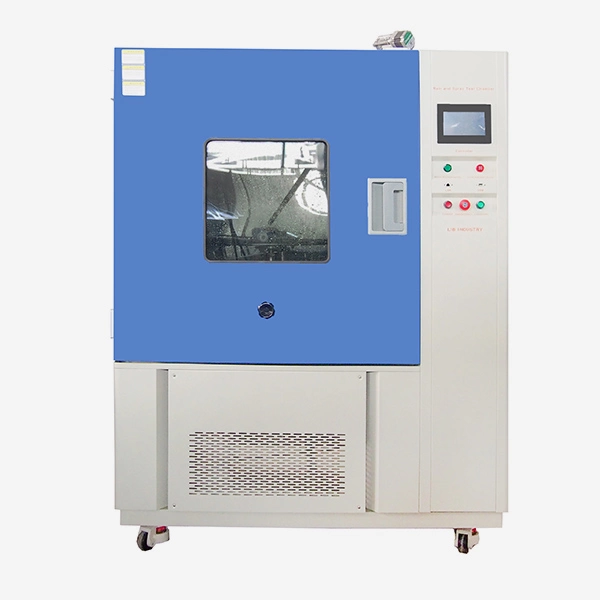
Waterproof testing equipment reproduces different forms of precipitation and water exposure under controlled laboratory conditions.
Depending on the required IPX rating, equipment may simulate:
Vertical dripping
Oscillating rain
Spray exposure
Water jets
High-pressure water
High-temperature water
For R&D teams, quality-control departments, and procurement engineers, a controlled water ingress test provides repeatable data for evaluating enclosure design.
A newly developed outdoor lamp, camera housing, automotive sensor, or electrical enclosure may appear properly sealed during visual inspection. However, microscopic gasket defects, assembly gaps, or poorly designed cable entries can allow water to penetrate.
Testing during prototype and production stages helps manufacturers identify these problems before products reach customers.
LIB Industry rain test chambers are designed for standardized waterproof evaluations across different IPX exposure conditions.
Ingress Protection ratings are primarily defined by IEC 60529 and describe the protection provided by an enclosure against solids and water.
Different IPX ratings use different water exposure methods.
| IPX Rating | Test Mechanism | Flow Rate / Specifications | Typical Application |
| IPX1 & IPX2 | Overhead Drip Box | 1–3 mm/min dripping | Indoor appliances, basic electronics |
| IPX3 & IPX4 | Oscillating Tube | Calibrated spray nozzles and defined oscillation angles | Outdoor lighting, cameras, electronic enclosures |
| IPX5 & IPX6 | Water Jet Nozzles | Approx. 12.5 L/min to 100 L/min | Marine equipment, telecom equipment, automotive products |
| IPX9K | High-Pressure / High-Temperature Water | Approx. 80°C water at 8000–10000 kPa | Automotive components, heavy machinery |
The lower waterproof protection levels focus on vertical dripping.
Testing equipment generally uses an overhead drip box fitted with calibrated needles or openings that deliver a controlled volume of water onto the product.
These tests are commonly used for:
Indoor electronics
Household appliances
Basic electrical housings
IPX3 and IPX4 evaluations use an oscillating tube or similar spray arrangement.
During a rain spray test, the chamber must accurately control:
Oscillation angle
Oscillation speed
Nozzle flow
Test duration
Specimen rotation
These levels are frequently required for outdoor products that may encounter rain from multiple directions.
IPX5 and IPX6 use water jets instead of gentle rain.
The equipment requires pumps capable of maintaining stable water delivery throughout the test.
IPX6 testing may require water flow rates up to approximately 100 L/min, so pump capacity and pressure stability become critical equipment specifications.
IPX9K is significantly more demanding.
Products are exposed to high-pressure water at elevated temperature.
Equipment designed for this test requires:
High-pressure pumps
Water heating systems
Heat-resistant piping
Suitable insulation
Reinforced chamber construction
For laboratories requiring multiple waterproof test levels, LIB Industry offers different rain test chamber configurations according to target IPX requirements.
Once the required IPX test method is identified, the next step is evaluating chamber specifications.
A waterproof test chamber must provide sufficient specimen space and stable water delivery while maintaining the required test geometry.
One common purchasing mistake is choosing a chamber that barely fits the largest test specimen.
Adequate clearance is required around the Device Under Test so water can reach the specimen uniformly.
Insufficient clearance may cause:
Water rebound from chamber walls
Uneven spray distribution
Restricted specimen rotation
Incorrect nozzle distance
Laboratories should therefore consider both current products and future testing requirements when selecting chamber size.
Standard chamber capacities may include configurations around 800 L, 1000 L, or other dimensions depending on application.
Accurate water delivery is essential for test repeatability.
Modern chambers commonly use digital flow monitoring instead of relying only on manual analog meters.
The system should maintain stable pressure even when flow demand changes.
This is particularly important for IPX5 and IPX6 testing, where high flow rates can place significant demand on pumps and piping.
A motorized turntable helps expose products uniformly from different directions.
When evaluating the turntable, check:
Rotation speed
Load capacity
Diameter
Height adjustment
Electrical supply options
Rotation speeds may typically fall within approximately 1–5 RPM depending on the test requirement.
For heavy components such as battery modules or automotive assemblies, load-bearing capacity becomes especially important.
Some systems may also use electrical slip rings so powered devices can operate during testing without cable entanglement.
Waterproof testing equipment operates continuously in a wet environment.
Material selection therefore affects chamber life, corrosion resistance, and maintenance requirements.
Internal walls and wetted components should use corrosion-resistant materials.
SUS304 stainless steel is widely used for:
Chamber interiors
Nozzles
Water pipes
Turntables
Drainage systems
Standard painted steel is less suitable for continuously wet internal environments because damaged coatings may eventually expose the substrate to corrosion.
LIB Industry rain test chambers use corrosion-resistant structural materials designed for repeated waterproof testing.
High-flow waterproof testing can consume substantial quantities of water.
A built-in water recycling system can capture runoff, filter it, and return it to the test circuit.
This reduces:
Water consumption
Operating cost
Manual water replenishment
Filtration is important because small particles can block calibrated nozzles.
Multi-stage filters help maintain cleaner circulation water and protect precision spray components during long-term use.
Modern waterproof testing requires consistent automated control.
Manual adjustment increases the possibility of operator error and makes repeated tests more difficult to reproduce.
A Programmable Logic Controller can automate:
Water flow
Pump operation
Test duration
Oscillation
Turntable rotation
Alarm functions
A touch-screen interface allows operators to enter test parameters and select programmed test procedures more efficiently.
For standardized IPX testing, automation helps reduce variation between operators.
Advanced systems may record important test parameters such as:
Flow rate
Water pressure
Water temperature
Test duration
Data can then be stored or exported for quality-control records.
Depending on the chamber configuration, communication functions may include:
USB
Ethernet
Remote monitoring
These functions are particularly useful for laboratories that need traceable test records for audits or customer documentation.
Procurement teams often need to decide whether a standard chamber is sufficient or whether a custom system is required.
Standard chambers are suitable for many common applications including:
Consumer electronics
Outdoor lighting
Automotive subcomponents
Sensors
Cameras
Electrical housings
Advantages include:
Lower acquisition cost
Shorter lead time
Proven configuration
Easier maintenance
For laboratories testing conventional specimen sizes and standard IPX requirements, a standard model is often the most practical choice.
Customized equipment becomes necessary when the product falls outside normal chamber capabilities.
Typical customization reasons include:
Large specimen dimensions
Heavy specimen weight
Special turntable capacity
Unusual nozzle positioning
Live electrical testing
Special IPX combinations
Automotive, aerospace, and industrial equipment manufacturers may require customized solutions because finished assemblies can be much larger than standard consumer products.
LIB Industry can provide standard and customized rain test chamber configurations according to specimen size and required testing method.
Choosing waterproof testing equipment involves evaluating both the machine and the manufacturer.
The supplier should understand the testing standards and provide technical documentation that clearly explains the chamber's capabilities.
Before purchasing, confirm compatibility with required standards such as:
IEC 60529
ISO 20653
Applicable automotive specifications
Customer-specific procedures
Equipment specifications should clearly indicate which IPX methods the chamber can perform.
Flow meters, pressure sensors, pumps, and temperature sensors can drift over time.
Regular calibration helps maintain accurate test conditions.
A reliable supplier should be able to provide:
Factory calibration documentation
Operating manuals
Technical guidance
Replacement components
After-sales service
For organizations seeking configurable waterproof testing equipment, LIB Industry provides rain test chamber solutions incorporating SUS304 stainless-steel construction, controlled water delivery, water recycling, touch-screen control, and turntable systems.
These systems can support a wide range of sealing performance tests for industrial and product-development laboratories.
Selecting the right rain test chamber begins with understanding the required IPX rating.
Once the target standard is confirmed, laboratories should compare:
Chamber size
Water flow
Pressure stability
Turntable capacity
Construction materials
Water recycling
Control systems
Supplier support
The correct configuration helps manufacturers generate repeatable data while reducing the risk of field failures caused by poor sealing or water ingress.
For manufacturers and laboratories planning to upgrade their waterproof testing capabilities, LIB Industry provides rain test chamber solutions for electronics, automotive components, lighting, telecom equipment, and industrial products.
If you are unsure which IPX level, chamber size, or spray configuration matches your product, contact LIB Industry for technical consultation. Share your specimen dimensions, required IPX rating, test standard, and application, and our team can help you evaluate a suitable waterproof testing solution.
Rain and spray testing exposes products to dynamic water from drops, spray, or water jets.
Immersion testing places the product underwater and evaluates sealing performance under hydrostatic pressure.
The two methods therefore simulate different water exposure conditions.
Purified water is generally recommended, especially for systems that recirculate or heat water.
Tap water can contain minerals such as calcium and magnesium.
Over time, mineral deposits may accumulate inside precision nozzles and affect water flow.
Distilled, deionized, or reverse-osmosis water can help reduce scaling and maintenance.
Usually not.
Different IPX levels require different mechanical systems.
For example:
IPX1–2 require drip systems.
IPX3–4 require oscillating spray.
IPX5–6 require jet nozzles.
IPX9K requires high-pressure, high-temperature water.
Some combination chambers can perform multiple IPX levels, but the supported ratings should be confirmed before purchase.
Yes, depending on the chamber configuration and test procedure.
Some applications require the Device Under Test to remain powered during exposure.
A waterproof electrical connection or slip-ring system may be used to provide power while allowing the specimen to rotate safely.
Test duration depends on the specific IPX rating and applicable standard.
For example, some IPX3 or IPX4 procedures may run for around 10 minutes, while IPX5, IPX6, and IPX9K procedures use different durations and water delivery requirements.
Always follow the exact IEC, ISO, or customer test procedure rather than applying one universal duration.
Many laboratories calibrate environmental test equipment at least annually, although the exact frequency depends on the quality system, equipment usage, and applicable standards.
Calibration should verify relevant parameters such as:
Flow rate
Water pressure
Temperature
Rotation speed
Timing
Regular calibration helps ensure the chamber continues to operate within required tolerances.


