
Views: 0 Author: LIB Team Publish Time: 2026-04-15 Origin: Site


A rain test chamber provides a controlled way to evaluate how products and enclosures respond to water exposure. It can be used for IP protection testing, waterproofing verification, and durability evaluations where repeatable water conditions are required. When selecting a chamber, testing capacity is not the only consideration— the available working space and chamber dimensions also need to match the size, quantity, and configuration of the products being tested.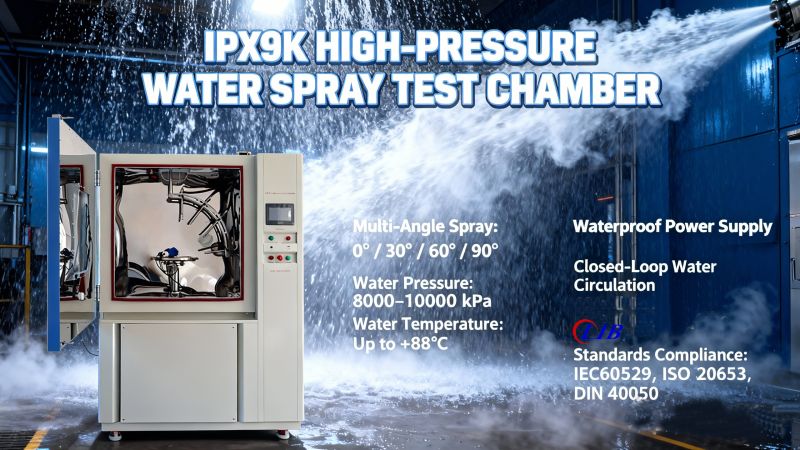
A recent feedback from a customer in the United States using a LIB IPX9K Rain Test Chamber highlights the equipment's reliability in real applications. The customer shared: “Hello, we have used the chamber many times and it continues to operate correctly. I appreciate you reaching out, all is well here.” This positive experience reflects the stable operation and dependable performance of LIB rain test chambers in daily testing environments.
This article explains how to choose the right Rain Test Chamber size by looking at key factors such as sample dimensions, test standards, installation space, and laboratory workflow. It also outlines common sizing mistakes and provides practical steps to help laboratories select equipment that supports accurate, efficient, and future-ready testing.
When labs compare rain test equipment, they often focus first on spray methods, IP ratings, or control systems. Those factors are important, but chamber size directly affects whether the test can be carried out correctly and efficiently.
A poorly sized Rain Test Chamber can create several problems:
the sample barely fits, leaving no room for rotation, fixtures, or proper spray exposure
water distribution may not match the intended test setup
operators may struggle to load or reposition the specimen safely
future products may require a second purchase sooner than expected
the lab may waste valuable floor space on an oversized system
In real procurement situations, sizing mistakes usually come from one of two assumptions: “bigger is always better” or “if the sample fits, the chamber is fine.” In practice, neither assumption is reliable.
The first sizing decision should be based on the test object itself.
Do not look only at the product's outer dimensions. You should also account for:
mounting fixtures or support frames
cable routing, hoses, or connectors during testing
required sample orientation
rotation or movement during the test
clearance between the specimen and chamber walls
operator handling space for loading and unloading
For example, a lab testing a compact electrical enclosure may think a small chamber is enough because the enclosure itself is not large. But once the mounting bracket, cable interface, and required spray exposure angle are added, the usable space requirement increases significantly.
A better rule is this: calculate the full test envelope, not just the product size.
This is the most basic factor, but it still needs careful handling. Measure:
length
width
height
weight
irregular protrusions
handling orientation during installation
If your product family includes several models, use the largest realistic specimen rather than the average one. Buyers who size equipment around their current best-selling model often run into limitations when a larger variant enters validation later.
In a Rain Test Chamber, internal space is not fully usable space. The specimen should not be packed tightly against chamber walls or spray components unless the test method specifically allows it.
Adequate clearance helps with:
more consistent water exposure
easier positioning
reduced risk of splash interference
better repeatability between tests
The required clearance depends on the test type, nozzle arrangement, and whether the specimen remains stationary or rotates. The exact setup should always be checked against the applicable product test requirement or standard used by your lab.
Many labs purchase rain test equipment for ingress protection or product durability work. In that case, chamber size must support the actual test method, not just the product footprint.
Typical considerations include:
whether the sample must rotate
whether oscillating tubes or specific nozzle systems need extra space
whether the test requires a defined spray distance
whether the specimen must be placed on a turntable or special fixture
If your lab is working with IP-related testing, chamber selection should be reviewed together with the exact test configuration you need to run. A chamber that is large enough physically may still be unsuitable if the internal arrangement cannot support the required test geometry.
Many buyers ask, “Should I size the chamber for one sample or multiple samples?” The answer depends on your lab's workload.
If your lab typically tests one engineering sample at a time, a compact system may be more efficient. If you regularly validate multiple parts in a batch, a larger chamber may improve throughput.
However, adding more samples should not compromise exposure consistency. A larger chamber is only beneficial when the internal layout still allows correct spray coverage and stable mounting.
This is especially important in quality labs where testing speed matters but repeatability matters more.
Manufacturers may describe chamber size using external dimensions, internal dimensions, or nominal volume. These are not the same thing.
Ask specifically about:
internal working dimensions
fixture occupancy
turntable size and load capacity
nozzle or oscillating tube intrusion into the chamber
door opening size
maximum specimen weight
This point is often overlooked. A chamber may appear large on paper but offer less usable space than expected once internal components are considered.
LIB provides several types of rain simulation equipment designed to meet different Ingress Protection (IP) and environmental testing requirements:
1. Drip Test Chambers (IPX1–IPX2)
These Rain Test Chambers simulate vertical dripping water using a calibrated drip box. They are commonly used to verify the basic waterproof capability of electronic enclosures, lighting equipment, and household appliances.
Test Item | IPX1 (Vertical Drip) | IPX2 (Inclined Drip) |
Water Source | Water drips from fixed holes on the top plate of the test chamber. | Under the same vertical dripping condition as IPX1, the sample is mounted on a 15° inclined tray. |
Drip Rate | 1 ml/min (hole diameter φ0.4 mm, spacing 20 mm) | 3 ml/min (same specifications) |
Hole Arrangement | Evenly distributed under the top plate. | Same as IPX1 |
Sample Holder Structure | Fixed horizontally, no rotating table required. | Equipped with a 15° inclined tray for quick installation/removal. |
Test Duration | 10 minutes | 2 minutes (or as per standard requirement) |
Evaluation Criteria | No water ingress or functional impact on the sample. | Drip direction changes, checking if sealing is effective on the inclined surface. |
2. Spray and Oscillating Tube Chambers (IPX3–IPX4)
This type uses oscillating tubes or spray nozzles to simulate rainfall or splashing water from multiple directions. It is widely applied in electronics, automotive components, and outdoor electrical equipment testing.
3. High-Pressure Water Jet Chambers (IPX5–IPX6)
These chambers generate powerful water jets to evaluate product resistance to high-pressure water exposure, such as cleaning processes or heavy rain conditions.
4. Immersion Test Systems (IPX7–IPX8)
Designed to simulate water immersion environments, these systems allow products to be tested at specific depths ranging from shallow water to deep immersion conditions.
5. High-Temperature High-Pressure Jet Chambers (IPX9K)
LIB IPX9K rain test chambers simulate extreme conditions such as high-temperature water jets up to 88 °C and pressures of 8000–10000 kPa. This test is commonly used in automotive and heavy-duty equipment industries where components must withstand intense washing environments.
LIB rain test chambers support the complete Ingress Protection waterproof test range from IPX1 to IPX9K, allowing laboratories to perform comprehensive waterproof verification with one integrated solution.
IPX1–IPX2: Drip tests that simulate vertically falling water droplets.
IPX3–IPX4: Oscillating tube or spray tests that simulate rain and splashing water from different directions.
IPX5–IPX6: High-pressure water jet tests that evaluate resistance to powerful water streams.

IEC 60529 IPX1/2/3/4/5/6 Combined Waterproof Test Chamber
IPX7–IPX8: Immersion tests that simulate water submersion at specified depths.

IPX7 IPX8 Water Immersion Tank
IPX9K: High-temperature (up to 88 °C) and high-pressure water jet testing used in demanding industries such as automotive and heavy equipment.

| Name | |
Internal Dimensions (mm) | 1000*1000*1000 | |
Overall Dimensions (mm) | 1300*1500*2030 | |
Interior Volume (L) | 1000 | |
Water Spray Angle | 0°, 30°, 60°, 90° | |
Water Spray Temperature | Ambient ~ +88℃ (Adjustable) | |
Spray Nozzle | Four, 30 Seconds each position | |
Distance from Water Spraying to Specimens | 10~15 cm | |
Water Pressure | 8000-10000 Kpa (Adjustable) | |
Water Flow Rate | 14L-16L/min | |
Testing Platform Speed | 5±1 r.p.m | |
Testing Platform Height | 200-400 nm (Adjustable) | |
Testing Platform Diameters | 600 mm |
Advanced control systems maintain stable water pressure, spray angles, temperature, and flow rate, ensuring consistent and repeatable test results that meet international testing standards.
Different spray systems, rotating turntables, adjustable nozzles, and sample fixtures allow LIB rain test chambers to accommodate a wide range of product sizes, shapes, and testing setups.
LIB rain test chambers comply with key international standards such as IEC 60529 (IPX1–IPX9K waterproof rating), ISO 20653 for automotive applications, ISO 16750 for vehicle electronic testing, SAE J575 / J1455 for automotive durability, MIL-STD-810H for military environmental testing, and other national IP standard. These certifications ensure that LIB equipment can accurately support global waterproof testing requirements and help manufacturers verify product compliance efficiently.
In addition to standard models, LIB provides custom rain test chambers for large samples, special fixtures, and integrated environmental testing systems to meet specific industry requirements.
Together, these advantages make LIB Industry Rain Test Chambers a reliable solution for manufacturers who require fast, precise, and standardized waterproof testing in laboratory environments.
A standard Rain Test Chamber works well for many labs, but not every application fits a standard cabinet.
A custom size may be worth considering when:
your product has unusual dimensions or shape
fixtures take up significant internal space
the sample is heavy or difficult to maneuver
you need to combine rain testing with other environmental conditions
your workflow depends on a specific loading method or production-style validation
Custom equipment is not always necessary, but for some labs it can improve usability and reduce compromises in daily operation.
The right Rain Test Chamber size for your lab should be based on testing reality, not assumptions. Start with the full test envelope, confirm the applicable method, review workflow and installation limits, and leave reasonable room for future needs. That approach helps you avoid both undersizing and unnecessary overspending.
If your team is comparing options, the most effective next step is to prepare a short sizing checklist with sample dimensions, fixture requirements, target test methods, and expected throughput. That information makes supplier discussions much more accurate and helps you choose a chamber that will still work well after your current project ends.
For manufacturers and labs evaluating long-term equipment value, a careful sizing decision often matters as much as spray performance or control features. A well-matched Rain Test Chamber supports better testing efficiency, more consistent results, and fewer procurement regrets.
If you're looking for reliable equipment for rain, water spray, immersion, or ingress protection testing, whether you need a Rain Test Chamber, an IPX1–IPX6 Combined Waterproof Test Chamber, an IPX7/IPX8 Water Immersion Test Tank, or an IPX9K High-Pressure High-Temperature Water Spray Chamber, don't hesitate to contact LIB Industry.
Contact LIB Industry today to discuss your rain and waterproof testing requirements and find the right chamber size for your products. With customizable testing configurations, support for IPX1–IPX9K waterproof testing, a 3-year warranty, lifetime technical support, 24/7 English-language service, and fast spare parts delivery, LIB Industry helps manufacturers and laboratories achieve reliable, repeatable, and efficient water ingress and rain testing.
LIB Industry Technical Team – Technical information, Rain Test Chamber specifications, chamber sizing, waterproof testing methods, customization, and application guidance for rain and water ingress testing equipment.


