


In today's fast-growing solar market, long-term reliability is no longer optional—it is essential. Photovoltaic (PV) modules must withstand extreme heat, humidity, UV radiation, salt spray, and rapid temperature fluctuations over decades of outdoor exposure. The 85°C/85%RH (Double 85) damp heat test has become a critical benchmark for evaluating module durability, ensuring stable power output and resistance to moisture-induced degradation.
Customers worldwide consistently report that LIB's PV 85/85 test chambers operate with outstanding temperature and humidity stability, accurate control, and long-term reliability. Field feedback highlights stable performance during continuous 1000-hour and extended 2000-hour tests, precise ± temperature/humidity uniformity, and easy system operation. Many users note that the chamber “runs steadily for long-term damp heat testing” and appreciate LIB's responsive technical support and preventive maintenance guidance—making it a dependable solution for rigorous PV reliability evaluation.
Introduction
The PV module 85°C/85% RH test chamber is designed for evaluating the reliability and performance stability of solar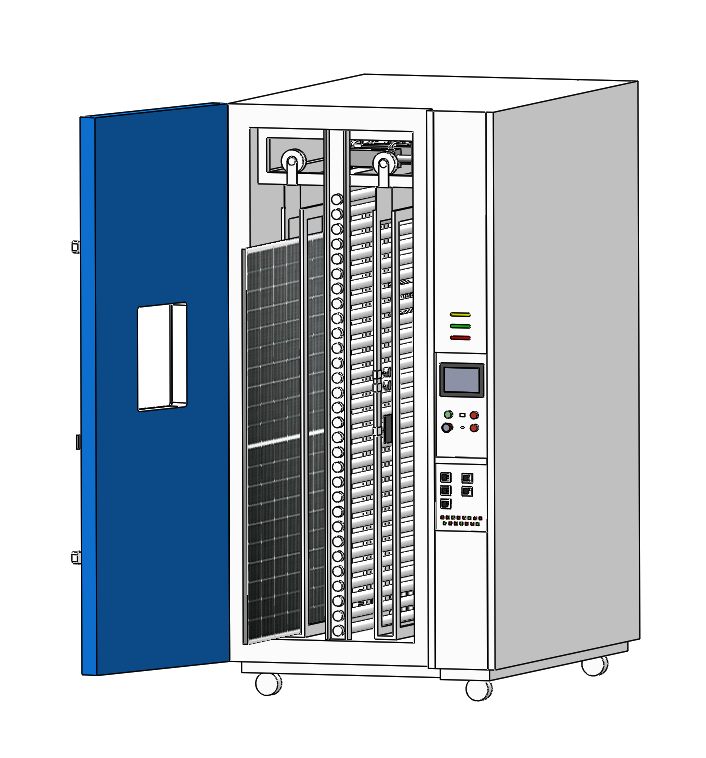 cells and photovoltaic modules under high-temperature and high-humidity conditions. It is widely used in laboratory testing and field quality inspection to assess power output stability and long-term durability.
The system operates by simulating a constant high-temperature and high-humidity environment, typically 85°C and 85% RH, to accelerate material aging and observe performance changes in photovoltaic components. During testing, the electrical characteristics and surface temperature of the samples are monitored over time, allowing engineers to analyze thermal-induced power drift and degradation behavior under controlled conditions.
By comparing initial and post-exposure performance data, the chamber enables quantitative evaluation of efficiency loss, thermal stability, and environmental adaptability of PV modules. This supports more accurate prediction of real-world outdoor performance under varying climatic conditions such as sunlight exposure, airflow variation, and humidity stress.
In addition, the equipment is designed for continuous operation with automated temperature and humidity control, ensuring stable and repeatable test conditions. Real-time monitoring and data acquisition functions allow users to track performance trends and record results efficiently without manual intervention.
Overall, the 85°C/85% RH test chamber plays a critical role in photovoltaic reliability testing, helping manufacturers improve product durability, validate design performance, and meet international testing standards for solar energy applications.
Relevant Standards for PV Solar Panel Reliability Test
In earlier photovoltaic standards, the backsheet was generally considered an integrated part of the PV module and was
tested and certified together with the complete system. However, as the industry's understanding of module reliability and long-term durability has deepened, dedicated testing approaches for both full modules and individual backsheet materials have gradually emerged and been refined.
International standardization efforts have been led by IEC Technical Committee 82, which is actively updating IEC 61730 for photovoltaic module safety certification. At the same time, new material-focused standards are being developed, including IEC 62788-2, which defines test procedures for front and back sheet plastics, and IEC 62788-7-2, which addresses accelerated environmental weathering tests for photovoltaic materials. These evolving standards reflect increasingly stringent requirements for material-level performance validation.
In parallel, the PV Quality Assurance Task Force (PVQAT), established in 2011, works to improve global photovoltaic quality assurance systems by promoting standardized evaluation methods and distinguishing durability differences among module designs. Within PVQAT, Working Group 5 focuses on studying the combined effects of temperature, humidity, and UV exposure on PV materials and components.
Furthermore, the U.S. National Renewable Energy Laboratory (NREL) has proposed the “Quality Plus” framework, which builds on IEC 61215 by extending test durations, optimizing test sequences, introducing advanced characterization techniques, and incorporating bias-stress conditions. This approach aims to better differentiate module quality and ensure long-term reliability under real-world operating conditions.
Damp Heat Aging, DH
Both IEC 61215 and IEC 61730 specify a 1000-hour damp heat aging test for photovoltaic modules to evaluate potential performance degradation, including power loss, leakage currents, delamination, and other failure modes.
Some backsheet manufacturers extend testing durations to 2000 or even 3000 hours. Under these more severe conditions, PET-based polyester materials may exhibit pronounced hydrolysis and embrittlement. However, this raises an important question: does such hydrolytic aging accurately reflect real-world outdoor failure mechanisms?
Analysis suggests that a 1000-hour damp heat test is generally sufficient to simulate the long-term hydrolytic degradation of PET materials across most global climatic environments, corresponding to approximately 25 years of field exposure. Experimental results further support that 1000 hours of 85°C/85% RH testing can reasonably represent long-term aging behavior in typical operating conditions.
As a result, the latest revision of IEC 61730 continues to require a 1000-hour damp heat test as a key reliability verification step for photovoltaic modules.
Internal Dimension (mm) | 1300*700*1350 | ||
Overall Dimension (mm) | 1900*1100*1750 | ||
Parameter | Temperature Range | -60℃ ~ +100 ℃ | |
Temperature Fluctuation | ± 0.5 ℃ | ||
Temperature Deviation | ± 2.0 ℃ | ||
Humidity Range | 20% ~ 98% RH | ||
Humidity Deviation | ± 2.5% RH | ||
Temperature Change Rate | 1 ~ 3.4℃ / Min | ||
Panel Size | 1M*2M | ||
Panel Capacity | 4 / 6 / 8 / 10 / 12 Pieces | ||
Material | Exterior Material | Steel Plate with protective coating | |
Interior Material | SUS304 stainless steel | ||
Thermal Insulation | Polyurethane foam and insulation cotton | ||
Real Object and Schematic Diagram | Interior lighting, double-layer therm; Observation Window; stability silicone rubber sealing | ||

UV Aging
IEC 61215 requires 15kWh/m2 UV pretreatment on the front of the module. The purpose of the test is to pretreat the module with ultraviolet (UV) radiation before the thermal cycle/wet freezing test to determine the UV attenuation of related materials and adhesion.

The industry has agreed that this dose is much lower than the actual UV exposure dose received by modules that have been outdoors for 25 years, and the air surface of the module backplane has not been exposed to UV radiation. Therefore, the draft international standard for backplane IEC 62788-2 and the national standard for backplane GB/T 31034-2014 both increase the dose of UV testing. According to the average annual UV radiation dose and 12% average UV reflectance in typical climate areas, the 25-year cumulative UV dose on the back of the module (junction box surface) in desert areas reaches 275kWh/m2, even in mild areas it reaches 171kWh /m2, equivalent to 11 to 18 times the UV pretreatment dose of IEC 61215.
UV Preconditioning Chamber | Name | UV Preconditioning Chamber |
Model | UVP-02 | |
Internal Dimension (mm) | 1450*745*2500 D*W*H | |
Overall Dimension (mm) | 1875*1210*2800 D*W*H | |
Specimen Holder Size(mm) | 1400*2400 W*H | |
Specimen Capacity | 2 Pieces | |
Irradiation Source | Fluorescent UVA lamps (20 pieces) and UVB lamps (10 pieces) | |
Temperature Range | Ambient ~ 90 ℃ ±2℃ | |
Black Panel Temperature (BPT) | 35 ~ 80 ℃ | |
Bandwidth | UVC: (< 0.1%) UVB: (3% to 10% of total UV) UVA: (90% to 97% of total UV) | |
Irradiance Control | ●The wavelength of 280 nm - 320 nm:7.5 k Wh/m2 ●The wavelength of 320 nm - 400 nm:15 k Wh/m2 ●Maximum Irradiance in the UV range: < 250 W/m2 | |
Controller | Programmable color LCD touch screen controller | |
Exterior Material | Steel Plate with protective coating | |
Interior Material | SUS304 stainless steel | |
Thermal Insulation | Polyurethane foam and insulation cotton |


In addition, it should be pointed out that the UV aging does not reach the corresponding UV dose to simulate the outdoor aging of the backplane material for 25 years. It is also necessary to design a reasonable sample structure and use an appropriate light source (for example, a high proportion of short-wavelength UVB may cause non-outdoor aging). Under the appropriate ultraviolet intensity and temperature, the influence of humidity and other environmental stresses is introduced, and the corresponding correlation is made with the long-term outdoor aging mechanism and degree.
Weathering Resistance
Weathering resistance test is a test method that combines ultraviolet radiation with temperature and humidity, and aging materials and components at the same time. The test standard can refer to ASTM G155-2005 (operation rules for xenon arc lamp equipment for exposure of non-metallic materials) ), has been widely used in the field of industrial products such as automobiles. Compared with the single test in the existing IEC61215, the weather resistance test combines the three important environmental factors of light, heat and humidity to investigate the aging of components and materials under the synergistic effect of multiple factors, which can better simulate the actual outdoor situation . Amendments to the second edition of IEC 61730 and IEC 62788-7-2(Photovoltaic Materials Testing Procedures - Part 7-2: Environmental Exposure - Accelerated Weathering Test of Plastics) During the drafting of the two standards, the weathering test was widely discussed and was once included in the text, but due to equipment and part Existing products are difficult to meet the test requirements and some manufacturers objected. Weather resistance testing has long been widely recognized in the photovoltaic field. The weather resistance test not only needs to control the intensity of light and temperature and humidity, in order to better simulate the outdoor environment, it also needs to spray the samples intermittently to simulate natural rain and night surface condensation, and use the adsorption and desorption of water by materials , to promote the aging of the material, and at the same time produce a temperature impact on the surface of the sample being irradiated. According to the general international standard ISO4892-2 plastics weathering resistance of plastics - method of exposure to laboratory light source (Part 2: Xenon arc lamp), the fracture of weathering resistance aging test of different backplane with and without spraying Changes in elongation were compared. It can be seen from the figure that the elongation at break of the hydrolysis-resistant and UV-resistant HPET1 polyester backplane does not decrease significantly after the xenon lamp aging test for 3000 hours, but after the introduction of appropriate water spray during the xenon lamp aging process, the polyester backplane and 1500 hours of aging, the elongation at break of the board decreased significantly.
Salt Spray Corrosion
The salt spray corrosion resistance test of photovoltaic modules mainly refers to the IEC61701-2011 (salt spray corrosion test of photovoltaic modules) standard, using 5% salt water spray and 50% humidity static cycle to evaluate the salt spray corrosion of materials. But even with the most stringent test level 7, the salt water spraying time in the test is only tens of hours, and the rest of the time is the resting time. It is difficult to simulate the real situation of the module used in the coastal environment for 25 years. The aluminum profile and aluminum-plastic panel industry generally adopts the AAMA 2605-5 standard (spontaneous design specifications, performance requirements and inspection procedures for organic coatings with excellent performance on the surface of extruded aluminum profiles and panels), and the long-term coating up to 4000 hours of salt spray corrosion test to evaluate the long-term salt spray corrosion resistance of the coating. Therefore, it is necessary to strengthen the salt spray corrosion test of components and backplane materials installed in coastal and saline-alkali areas.
Summary
The photovoltaic industry is developing rapidly and has a complete photovoltaic industry and market. The rapid development and frequent product quality problems have also attracted the attention of relevant manufacturers, certification agencies, investors and the government. In order to speed up the transformation and upgrading of the photovoltaic industry, it is necessary to establish scientific and complete supporting standards as soon as possible to regulate the photovoltaic industry and ensure the healthy, orderly and rapid development of the market.
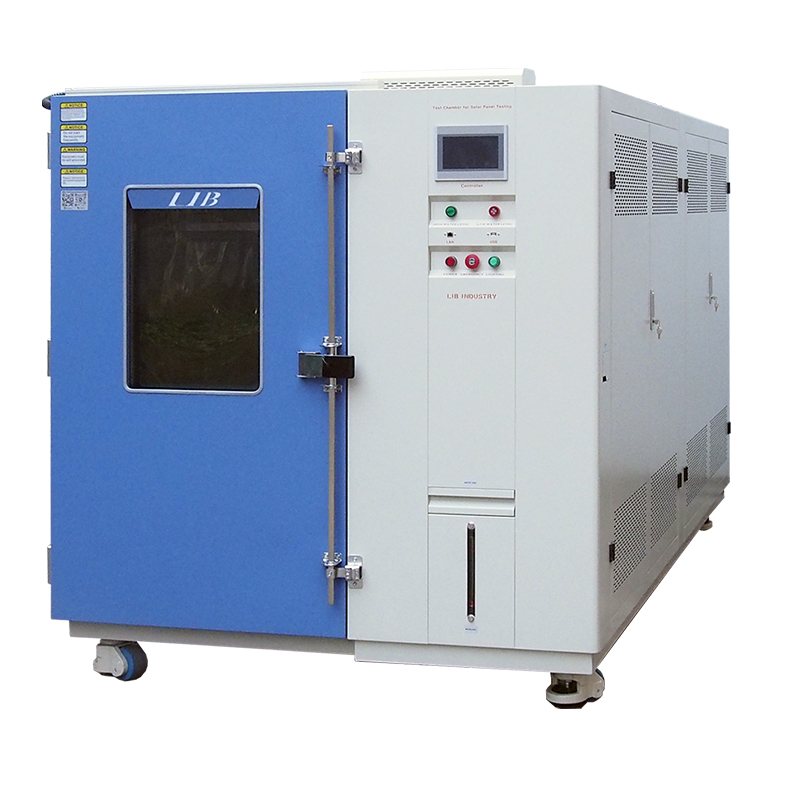
LIB Test Chambers For Solar Panel Testing
LIB Test Chamber For Solar Panel Testing is for PV modules( solar panels) thermal cycling, humidity freeze cycle, and damp heat RH testing, to test whether PV modules can withstand high temperature with humidity and low temperature, to test its fatigue and thermal failure after temperature repeated changes, to confirm its thermal stress PV modules generated under high humidity circumstance and capacity of long-term resistance to moisture penetration. This test chamber is widely used in solar panels testing.If you need help to test your PV Solar Panels, contact LIB Industrynow. LIB will provide you with the best equipment and solutions.


