


In modern laboratories, precision environmental control is no longer optional — it is essential. Whether cultivating microorganisms, performing seed germination studies, conducting material stability tests, or simulating extreme environmental conditions, a constant temperature and humidity test chamber ensures reliable, repeatable, and accurate results. From biology and medicine to electronics and agriculture, these chambers provide a stable platform for research, quality control, and product validation.
Recently, one of our customers shared positive feedback after using the LIB constant temperature and humidity chamber. They highlighted the chamber’s easy operation, precise temperature control, and excellent stability during long-term testing. The programmable controller and uniform air circulation allowed their experiments to run smoothly without temperature fluctuation concerns. This real-world application once again proves that a high-performance environmental chamber is not just equipment — it is a dependable research partner.
Constant temperature and humidity test chamber
A constant temperature and humidity test chamber is a type of environmental simulation equipment used to maintain stable and
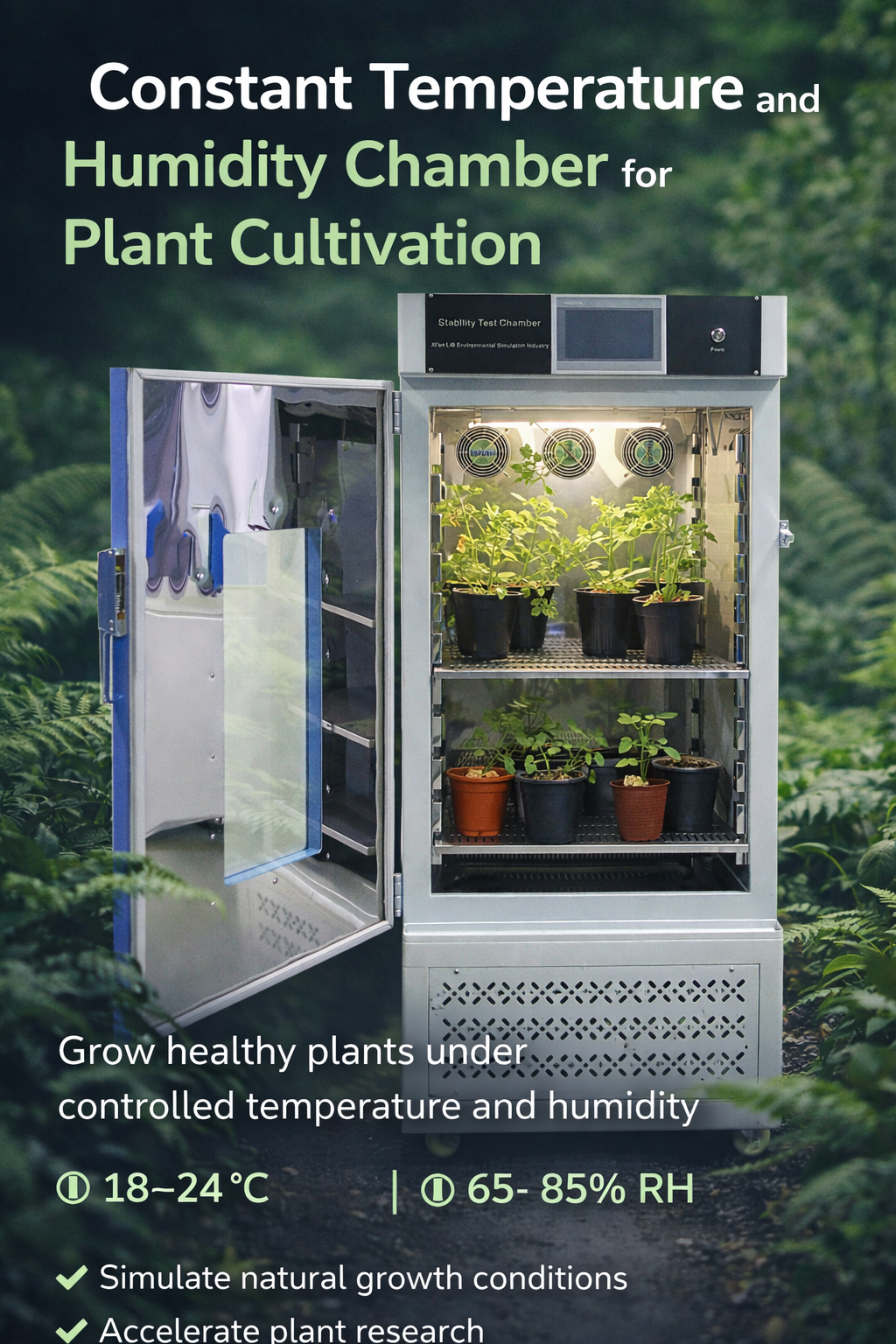
controlled temperature and humidity conditions for testing and research purposes. It is widely applied in scientific research institutions, industrial manufacturing, and quality inspection processes. By creating a precisely controlled environment, it allows users to study how materials, biological samples, and electronic products respond to different environmental conditions in a repeatable and reliable way.
This type of equipment is commonly used in fields such as biology, medicine, microbiology, and pharmaceuticals. In these areas, it provides a stable environment for cultivating microorganisms, cells, and tissue samples, helping researchers obtain consistent and accurate experimental results. Because biological processes are highly sensitive to environmental changes, even small fluctuations in temperature or humidity can significantly affect outcomes, making this equipment essential for controlled experiments.
In industrial applications, constant temperature and humidity chambers are used to test the performance and reliability of electrical products, electronic components, and various materials under changing environmental conditions. Manufacturers use these tests to evaluate product stability, durability, and resistance to environmental stress before products are released to the market. This helps reduce failure risks and ensures product quality in real-world usage conditions.
The equipment is also widely used in agriculture and biotechnology. In seed germination studies, plant breeding experiments, and cultivation of new agricultural varieties, stable environmental control is essential for ensuring predictable growth results. In poultry incubation, maintaining consistent temperature and humidity conditions can significantly improve hatch rates and reduce variability, making the process more efficient and reliable.
One of the key advantages of a constant temperature and humidity test chamber is its ability to simulate a wide range of environmental conditions, including both high and low temperatures as well as different humidity levels. The system is designed to maintain gradual and stable changes rather than sudden fluctuations, which helps create realistic testing conditions similar to natural environments while still allowing accelerated testing when needed.
In daily life, the same principle can be seen in many common devices such as incubators, temperature-controlled aquariums, and plant growth boxes. These systems all rely on the idea of maintaining stable environmental conditions to support biological or functional stability. This demonstrates that environmental control technology is not only used in laboratories and industries but is also closely connected to everyday applications.
LIB Incubator
The incubator refers to the basic equipment that can control the temperature and is mainly used in the medical laboratory to cultivate microorganisms, cells, tissues and other organisms in vitro.
LIB Incubator | Model | I-150 | I-200 | |||
Internal Dimension (mm) | 500*380*800 | 540*540*900 | ||||
Overall dimensions (mm) | 600*580*1200 | 740*740*1540 | ||||
Interior Volume (L) | 150L | 200L | ||||
Power | 350W | 420W | ||||
Temperature Range | +5℃ ~ + 50 ℃ | |||||
Temperature Fluctuation | ± 0.5 ℃ | |||||
Temperature uniformity | ±1 °C | |||||
Temperature fluctuation tolerance | ±1 °C | |||||
Temperature uniformity tolerance | ± 2 ℃ | |||||
Humidity Range | 30% ~ 90% RH | |||||
Humidity Deviation | ± 5% RH | |||||


|
|
Workroom The internal material is 304 stainless steel with mirror surface. The four corners have a circular arc shape, which makes the temperature inside the cabinet uniform, durable and easy to clean. | Sample shelves SUS304 stainless steel punching sample shelf 2pcs; Standard load of 50KGS for each layer of sample shelf; The height of the shelf is adjustable and can be removed. It is conducive to the air circulation. |
|
|
| LAN & USB | Inner light |


The medical incubator is the basic equipment for cultivating microorganisms, cells, tissues and other organisms in vitro by artificially imitating the growth and reproduction environment of bacteria and other microorganisms, such as suitable temperature, humidity, gas, etc. In clinical experiments, the incubator can be used for pathogen isolation, culture, identification and drug sensitivity test on blood, cerebrospinal fluid, respiratory and reproductive tract secretions, pus and other body fluids and tissue samples.
The commonly used types are:
- electric heating constant temperature incubator,
- bacterial incubator,
- anaerobic incubator,
- biochemical incubator.
How the incubator works?
The medical incubator mainly uses artificial methods to form a growth environment similar to cells, tissues, microorganisms, etc. in the body or in a specific situation by simulating in the incubator, such as a certain temperature, a certain humidity, a certain light or a certain level of carbon dioxide, a certain pH, etc., to a device for in vitro culture of cells, tissues, and organisms.LIB incubator can best meet your needs:
Instructions:
1. Operators need to read the instructions carefully, understand and be familiar with the functions of the incubator before turning on the power.
2. Turn on the power, press the power switch, and the power indicator light will be on.
3. Adjust the temperature controller to the set temperature value required by the user.
4. When the display temperature of the incubator reaches the set temperature, the heating is interrupted and the heating indicator light goes out. After 90 minutes of power-on at the standard ambient temperature, the temperature can remain stable. If the instant temperature in the incubator exceeds the set upper limit alarm temperature, the temperature control The instrument temperature tracking alarm indicator light is on, and the heater power is automatically cut off at the same time.
5. If the glass door is opened to take samples, the heater and circulation fan will stop working. After the glass door is closed, the heater and fan can operate normally, which can avoid the pollution of the culture and the overshoot of the temperature.
Features
1.Workroom
The internal material is 304 stainless steel with mirror surface. The four corners have a circular arc shape, which makes the temperature inside the cabinet uniform, durable and easy to clean.
The shelves in the workroom are adjustable.
2.Sample Shelf
SUS304 stainless steel punching sample shelf 2pcs; Standard load of 50KGS for each layer of sample shelf; The height of the shelf is adjustable and can be removed. It is conducive to the air circulation.
3.Viewing Window
Double-layer all-glass construction ensures good observation and insulation.
4.Controller
PID programmable controller, network connection computer. Can set 99 programs 30 segments.
Programmable multi-segment control mode, temperature and illuminance can be set separately during day and night.The set system language is English for standard.
5.Castor
Install 4 castors for easy to move, and with brakes function. Caster height is adjustable.
6.External Materials
A3 steel plate with galvanized coating; Electrostatic treatment; High and low temperature corrosion resistance; High hardness, anti - impact. Very high safety factor;
Application case
For soybeans, many people come to cultivate bean sprouts. If they are only used to cultivate bean sprouts and study the germination rate, they do not need light at all, but need to avoid light. So ordinary incubators are enough. If constant humidity is necessary, a constant temperature and humidity chamber can also be used. For different research contents, the incubators used are different, and the temperature, humidity, and illuminance are also different.Seed germination is very sensitive to temperature. The minimum temperature for germination is 6°C, and the temperature for emergence is 8-10°C. Seedlings are slightly damaged by freezing at a low temperature of -4°C. During the whole growth period, the optimum growth temperature of soybean is the daily average temperature of 20-25°C, among which the optimum growth temperature of seedlings is 20-21°C, the flower bud differentiation period is 21-23°C, the flowering period is 22-25°C, and the pods are set. The bulging stage is 21-23°C, and the mature stage is 19-20°C. The accumulated temperature required for the entire growth period generally requires 2400-3800°C.
The new intelligent living vegetable sprouting machine starts a healthy life and produces green products. If you want to eat healthy organic matter and clean food, you can do it with only one sprouting machine.
Common germination machines need to soak for 8-24 hours in advance before starting to propagate seeds. Sprouts are the most nutritious of all raw foods, this is because the natural substances are retained during the growth process, and the basic components of the bean to bean sprouts have not changed. The sprouts essentially retain the nutrients from the sprouts and are easily digested, which conserves your body's energy. Sprouted seeds are easily digestible whether eaten raw or cooked, and compared to all legumes, sprouts contain something called high bio-efficiency value. Bean sprouts have a renewal effect in the human body, why? It depends on the abundance of RND, DNA, proteins and minerals essential to human cells.
The Functions and Differences of Several Incubators
As the incubator is a very common laboratory instrument, but as what I mentioned above, we often encounter various incubators, such as:
- constant temperature incubator,
- constant temperature and humidity incubator,
- carbon dioxide incubator,
- anaerobic incubator,
- mold incubator,
- light incubator etc. what is the difference?
1. Constant temperature incubator
The constant temperature incubator is suitable for ordinary bacterial culture and closed cell culture, and is often used for pre-warming of equipment and reagents related to cell culture.
Features: heating control, without refrigeration.
Electric heating is adopted, the inner tank is made of stainless steel, the insulation layer uses asbestos as the insulation material, and there is a heating tube at the bottom to heat the chamber through the heating tube.
2. Constant temperature and humidity chamber
The constant temperature and humidity incubator can accurately simulate complex natural environments such as constant temperature and humidity, and is a kind of chamber with a precise temperature and humidity control system.
Features: temperature control, humidity control
It is generally used for plant culture and breeding tests; various constant temperature tests such as microbial culture and fermentation, environmental tests, material denaturation tests, and storage of culture media, serum, drugs, etc. Widely used in medical and health, biopharmaceutical, agricultural research, environmental protection and other research and application fields.
3. Biochemical incubator
This incubator is equipped with electric heating wire heating and compressor cooling at the same time. Therefore, it can adapt to a wide range and can be kept at a constant temperature throughout the year, so it is gradually becoming popular. The use and maintenance of this incubator is similar to that of an electric incubator. Since a compressor is installed, precautions for refrigerator maintenance must also be followed, such as keeping the voltage stable, not over-tilting, and cleaning the dust on the radiator in time.
Features: Biochemical incubators generally do not have humidity control and anti-virus functions. It has dual system cooling and heating temperature control. Usually with a glass observation window.
The biochemical incubator is an indispensable laboratory equipment for the scientific research of plants, biology, microorganisms, genetics, viruses, medicine, environmental protection, etc., and the education department. It is widely used in low temperature and constant temperature experiments, cultivation experiments, and environmental experiments.
4. Mold incubator
The mold incubator is a test equipment suitable for cultivating eukaryotic microorganisms such as mold, because most molds are suitable for growing at room temperature (25 ℃), and a certain humidity needs to be maintained when cultivating on a solid substrate, so the general mold incubator is refrigerated System, heating system, air humidifier and cultivation room, control circuit and operation panel, etc., and use temperature sensor and humidity sensor to maintain the stability of temperature and humidity in the cultivation room. Some special mold incubators can also set the temperature and humidity to change with the cultivation time.
Features: dual-system cooling and heating control, heating, cooling, humidity control
This product is suitable for environmental protection, sanitation and epidemic prevention, agricultural and livestock, drug inspection, aquatic products and other scientific research, college experiments and production departments. It is a special constant temperature and constant temperature oscillation equipment for water analysis; BOD determination of bacteria and mold; cultivation and preservation of microorganisms; plant cultivation and breeding experiments.
5. Carbon dioxide incubator
The carbon dioxide incubator is to form a growth environment similar to cells/tissues in the organism by simulating in the incubator box. The incubator requires a stable temperature (37°C), a stable CO2 level (5%), and a constant pH value (pH value : 7.2-7.4), high relative saturation humidity (95%), a device for in vitro culture of cells/tissues.
Features: temperature control, generally only with heating, high temperature sterilization, some with refrigeration, CO2 level control, pH control, humidity control.
Carbon dioxide incubators are widely used in the cultivation of cells, tissue cultures and some special microorganisms. They are commonly used in the study of cell kinetics, the collection of mammalian cell secretions, the carcinogenic or toxicological effects of various physical and chemical factors, the research of antigens and Production and cultivation of hybridoma cells to produce antibodies, in vitro fertilization (IVF), stem cells, tissue engineering, drug screening and other research fields.
Due to the increased control of carbon dioxide concentration and the use of a microcontroller to precisely control the temperature of the incubator, the success rate and efficiency of the cultivation of biological cells and tissues are improved. In short, the carbon dioxide incubator is a new type of incubator that cannot be replaced by ordinary electric heating constant temperature incubators.
Summary
We have learned so much environmental incubators in Biological Field and know the differences among them. Which kind of incubator do you need for your lab?
LIB Industry will give you suggestion and provide you with the quality machine and the best solution for your needs.


