Views: 0 Author: Site Editor Publish Time: 2026-06-01 Origin: Site


Unforgiving weather destroys commercial products daily. Material degradation causes severe financial losses across global manufacturing industries. Photochemical reactions cause dangerous structural embrittlement in plastics. Relentless ultraviolet rays trigger rapid color fading and gloss loss on exterior paints. These unexpected material failures result directly in massive warranty claims. They cause catastrophic product failures and inflict immediate brand damage. Manufacturers simply cannot wait several years to observe natural outdoor weather damage. They demand faster, highly reliable durability data.
A Xenon Test Chamber solves this precise testing bottleneck. It remains the absolute industry standard for replicating years of severe sun, heat, and moisture damage. It successfully compresses natural outdoor degradation into mere days or weeks. This article moves beyond basic weathering concepts. We focus entirely on the core mechanism driving these accelerated results: the test cycle. You will learn exactly how these programmable sequences function. Evaluating a chamber's capacity to execute complex, standard-compliant cycles represents the most critical step in your entire procurement process.
1. The baseline industry standard for weathering is the ASTM G155 cycle (typically 102 minutes of light, followed by 18 minutes of light and water spray).
2. Test duration vs. real-world exposure is quantifiable (e.g., ~2360 hours at specific irradiance levels can equate to one year of harsh South Florida exposure), but acceleration rates depend heavily on material chemistry.
3. Advanced testing protocols now require chambers to handle severe thermal shock, extended dark-spray cycles, and closed-loop irradiance compensation to maintain strict standard compliance.
4. Selecting a Xenon Test Chamber requires matching hardware architectures (air vs. water cooling, flat vs. rotating racks) to your specific material testing protocols and specimen types.
A test cycle functions as a highly precise, programmable sequence. It artificially simulates the three primary forces causing natural weather degradation. These destructive forces include full-spectrum sunlight, extreme surface heat, and fluctuating moisture levels. When operators program a Xenon Test Chamber, they explicitly dictate how to combine these natural forces.
The ASTM G155 benchmark remains the most universally referenced non-metallic weathering standard globally. Laboratories rely extensively on this specific cycle to establish initial baseline durability. We can break this classic cycle down into two distinct functional phases:
Phase 1 (Dry Exposure): The chamber runs 102 minutes of continuous, unyielding full-spectrum light. This aggressive phase bakes the specimen and actively initiates photochemical bond breakdown.
Phase 2 (Wet Exposure): The subsequent 18 minutes combine this intense light alongside a direct front-surface water spray. This sudden moisture introduction induces rapid thermal shock and physical erosion.
Executing this rigorous sequence requires tracking specific operational metrics. Reliable machines measure three core cycle parameters continuously:
1. Irradiance: This represents the standardized energy output hitting the material sample. A typical benchmark setting requires an output of 0.35 W/m² measured precisely at the 340 nm wavelength.
2. Black Panel Temperature (BPT): This simulates the maximum physical surface heat a dark material absorbs outdoors. Operators usually set the BPT to 63°C during the dry exposure phase.
3. Relative Humidity (RH): Chamber sensors hold ambient moisture at exactly 50% during the dry cycle. Controlling humidity directly dictates how much internal moisture a material absorbs before the wet phase triggers.
Why do these specific test sequences matter so much? The answer lies in the incredible ROI of time. Product managers and executives constantly race against aggressive launch deadlines. Shrinking a 12-to-36-month physical outdoor testing phase holds immense commercial value. A well-calibrated Xenon Test Chamber compresses this tedious waiting period into a tight, manageable laboratory schedule.
We can quantify this timeline conversion using established industry data. Material scientists provide an evidence-backed baseline for South Florida natural exposure. Testing materials at an increased irradiance of 0.55 W/m² requires a specific structural approach. You must utilize a continuous light, dark, and moisture cycle. Running this sequence for roughly 2360 hours widely equates to one full year of natural South Florida weathering. This conversion gives development teams a tangible, data-driven target for assessing product durability.
However, you must approach time equivalence claims cautiously. We strongly advise treating these hour-to-year conversions as estimates rather than absolute scientific laws. Actual degradation rates depend heavily on specific polymer structures and coating chemistries. Some plastics break down exponentially faster under continuous ultraviolet exposure. Other textiles might resist bright light but fail quickly under high moisture stress. Comparative testing always remains more valid. You should test new prototypes directly against known benchmark materials. This comparative method yields much stronger data than relying on absolute time claims alone.
The traditional 102/18 test cycle originated in the 1920s. It provided an excellent starting point for early material science. However, modern commercial materials often demand much more aggressive and nuanced testing protocols. A high-end Xenon Test Chamber must evolve dynamically to meet these modern engineering standards. Leading automotive and aerospace manufacturers continuously push testing boundaries forward.
Recent industry workshops reveal critical limitations in older legacy standards. Aggressive plastics and advanced composite coatings degrade more realistically under forced dark-spray cycles. A highly effective modern testing protocol utilizes 23 hours of continuous light exposure. The machine immediately follows this with 1 hour of intense dark water spray. Operators often combine this specific cycle alongside manual physical washing routines. This specialized sequence successfully simulates outdoor dirt accumulation and natural acid rain removal.
Thermal shock testing represents another crucial modern cycle variation. Consider a dark automotive exterior panel baking under the intense summer sun. High irradiance builds severe ambient heat deeply across the substrate. A sudden rainstorm subsequently hits the hot panel surface. This rapid cooling creates intense mechanical stress and immediate physical contraction. Advanced test cycles recreate this exact physical mechanism indoors. The chamber blasts the heated specimen using a sudden cold water spray. Micro-cracking and material delamination occur very quickly. If you test exterior automotive parts, your equipment must confidently execute these violent thermal shocks.
A programmed test cycle is only as reliable as the underlying machine hardware. You cannot achieve accurate weathering results using poor optical components. Spectrum accuracy dictates everything during an accelerated test.

Optical filters define the exact light spectrum hitting your material samples. We utilize three primary filter categories to modify the bare xenon light:
1. Daylight Filters: These provide a highly precise 290nm short-wave cut-off. They perfectly replicate the harsh reality of direct, outdoor summer sunlight.
2. Window Glass Filters: These physically block lower-wavelength ultraviolet radiation. They accurately simulate natural sunlight filtering through standard commercial glass. You absolutely need these for automotive interiors and indoor residential textiles.
3. Extended UV Filters: These allow shorter, highly aggressive ultraviolet wavelengths to pass through unhindered. They severely accelerate testing timelines for incredibly durable aerospace materials.
Below is a summary chart comparing these essential optical filters:
| Optical Filter Type | Primary Cut-Off Wavelength | Simulation Goal | Primary Industry Applications |
|---|---|---|---|
| Daylight Filter | ~290 nm | Direct outdoor natural sunlight | Exterior paints, roofing, outdoor plastics |
| Window Glass Filter | ~310 nm | Sunlight passing through window glass | Automotive dashboards, indoor furniture |
| Extended UV Filter | Below 290 nm | Extreme accelerated physical damage | Aerospace composites, rapid R&D screening |
Closed-loop irradiance control serves as a mandatory buyer criterion. Xenon arc lamps inevitably age during continuous operation. As they age, their energy output naturally drops. The chamber must possess automated optical sensors located near the sample rack. These intelligent sensors continuously measure the exact light energy hitting the sample plane. When the sensor detects an energy drop, it automatically boosts electrical power to the lamp. This critical feature maintains exact irradiance setpoints throughout the entire months-long test cycle.
Moisture and purity standards require equal attention from lab operators. Executing a spray cycle demands exceptionally pure water. You must strictly use high-purity deionized water for all spray functions. The water conductivity must remain below 0.2 μS. Furthermore, silica content must stay tightly under 0.1 ppm. Ignoring this fundamental rule causes artificial water spotting. Hard mineral deposits will quickly bake onto your test specimens. These white deposits block light penetration, drastically skewing optical degradation results.
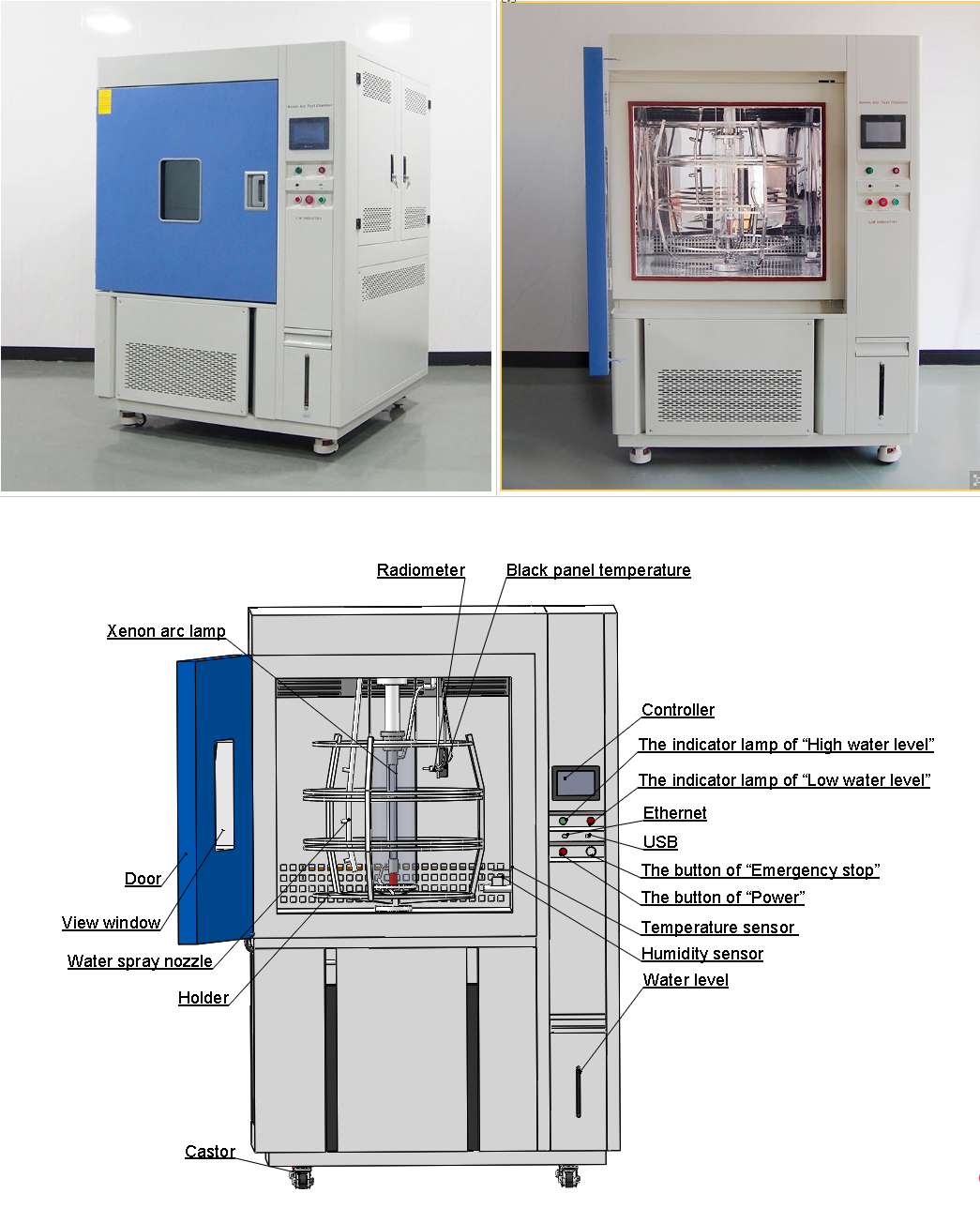
Model | XL-S-750 |
|
Internal Dimension (mm) | 950*950*850 mm | |
Overall Dimension (mm) | 1400*1400*1950 mm | |
Specimen Holder Size(mm) | 95*180 | |
Specimen Capacity | 42pcs | |
Chamber Type | Rotating Holder | |
Irradiation Source | 1 piece of 4500w water-cooled xenon arc lamp | |
Irradiance Range | 35~150 W/㎡ | |
Bandwidth Measurement | 300nm~400nm (340nm or 420nm) | |
Chamber Temperature Range | Ambient ~ 100 ℃ ±2℃ | |
Black Panel Temperature | BPT 35 ~ 85 ℃ ±2℃ | |
Humidity Range | 50% ~ 98% RH | |
Humidity Deviation | ± 5% RH | |
Water Spray Cycle | 1~9999H59M (Adjustable) | |
Controller | Programmable color LCD touch screen controller | |
Water supply system | Automatic water supply, Water purification system | |
Radiometer | UV Radiometer, Tolerance: ±5% | |
Cooling System | Mechanical compression refrigeration system | |
Safety Device | Over-temperature Protection; Over-current Protection; Water Shortage Protection; Earth leakage Protection; Phase Sequence Protection | |
Exterior Material | Steel plate with protective coating | |
Interior Material | SUS304 Stainless steel |
Equipment procurement requires matching chamber architecture directly to your specific application. A modern Xenon Test Chambercomes in several distinct structural designs. Each design serves a different engineering purpose.
Specimen mounting presents the first major architectural decision. Rotating racks work best for high-volume thin films, delicate textiles, and standard flat coatings. The constant rotation ensures absolute light and moisture uniformity across hundreds of small samples simultaneously. Flat shelf arrays offer a completely different operational advantage. You absolutely need flat shelves for testing thick 3D parts, irregular geometric shapes, or full automotive sub-assemblies.
Internal cooling mechanisms also dictate your cycle capabilities. You must choose between air-cooled and water-cooled hardware architectures:
1. Air-Cooled Chambers: These offer substantially lower initial purchase costs. They ensure easier lab installation since they bypass complex plumbing requirements. They work exceptionally well for textiles and standard plastic evaluations. However, they generate more ambient fan noise. They also tolerate slightly broader temperature fluctuations during complex cycles.
2. Water-Cooled Chambers: These provide exceptional internal heat dissipation. They easily handle higher wattage lamps and extreme "3-SUN" irradiance levels peaking up to 180 W/m². You essentially need water cooling for strict automotive and aerospace tolerances. Keep in mind they require dedicated laboratory plumbing infrastructure.
Managing experimental deviation requires proactive operational protocols. Distinct temperature gradients exist inside all environmental test chambers. You might occasionally see up to a 12°C difference across a large stationary sample rack. Buyers must look for software featuring programmable cycle pauses. These intelligent pauses prompt lab operators to perform mandatory physical sample rotation. Routinely moving samples ensures balanced light exposure and totally prevents anomalous degradation data.
The true value of accelerated testing lies entirely in strict protocol execution. A premium test chamber must run repeatable, heavily documented sequences automatically. Proper material simulation hinges heavily on exact irradiance levels, accurate temperature controls, and highly pure water spray. Operating without these controls wastes time and produces invalid data.
Here are your actionable next steps for upgrading your laboratory capabilities:
1. Audit your current material testing standards first. Identify whether you strictly require ASTM, ISO, or SAE compliance before reviewing equipment.
2. Evaluate the manufacturer's optical filtering capabilities carefully. Ensure they supply exact daylight or window glass filter matches for your products.
3. Assess your current lab infrastructure. Decide whether you can support water cooling systems or if you require an air-cooled setup.
4. Review the chamber software control logic extensively. Demand closed-loop irradiance feedback and automated operational calibration prompts.
A: A Xenon test cycle simulates the entire sunlight spectrum. It accurately includes ultraviolet, visible, and infrared light. This broad spectrum makes it ideal for testing color fading and visual degradation. Conversely, a fluorescent UV test cycle only generates targeted short-wave ultraviolet light. UV testing focuses strictly on simulating extreme physical property damage like deep cracking or severe polymer embrittlement.
A: Test duration depends entirely on the specific standard you follow. Testing basic indoor textiles might take just a few short days. Conversely, evaluating highly durable automotive exterior coatings can require thousands of continuous hours. Always consult your specific ASTM or ISO standard to determine the precise baseline timeframe required for your unique materials.
A: Yes, advanced environmental chambers successfully simulate harsh acid rain environments. Premium machines feature specialized dual-spray systems. These upgrades allow operators to program secondary fluid accessories. You can introduce mildly acidic solutions or specialized soap sprays specifically during the dark cycle. This replicates aggressive natural chemical phenomena alongside standard UV and thermal stress.
Contact LIB Industry today to discuss your testing requirements and discover the ideal Xenon Test Chamber solution for your materials, products, and industry standards.