Views: 0 Author: Site Editor Publish Time: 2026-04-07 Origin: Site


A Rain Test Chamber and a spray test chamber are not always the same thing, even though buyers sometimes use the terms interchangeably. In most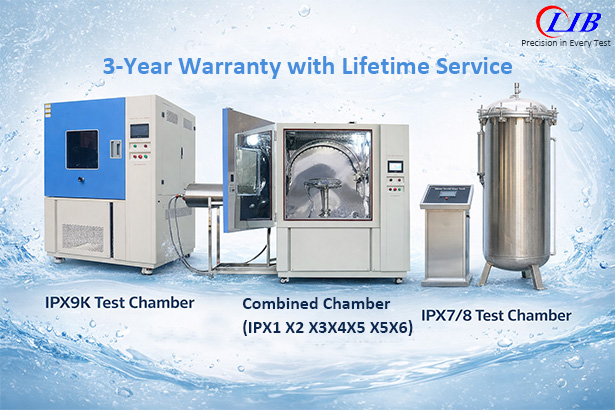 real purchasing and testing scenarios, a Rain Test Chamber is designed to simulate rainfall or water ingress conditions in a more defined and repeatable way, while a spray test chamber can refer more broadly to equipment that applies water spray to a specimen for washing, splash, surface exposure, or simplified spray evaluation.
The key difference is purpose. If your goal is to evaluate how a product resists rain, dripping, splashing, or water penetration under a controlled method, a Rain Test Chamber is usually the more precise term and often the more appropriate system. If your application only requires general spray exposure, rinsing simulation, or a less standardized spray process, a spray test chamber may be enough.
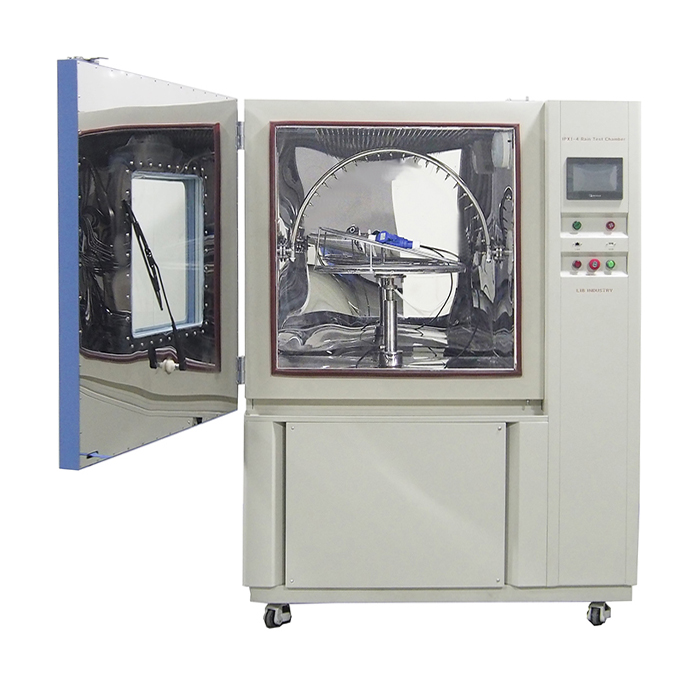
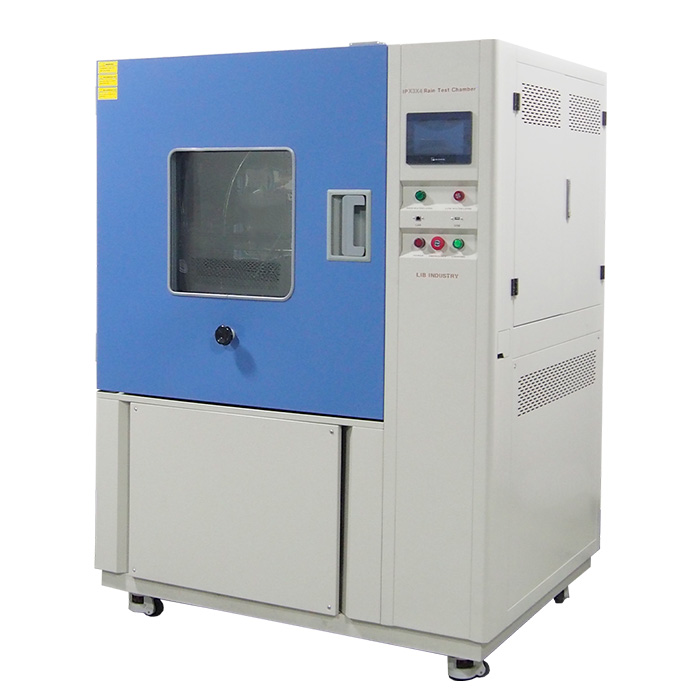
A customer in the U.S. recently shared their experience with LIB's RD-800C Rain Test Chamber : “We purchased this model to develop new outdoor products, including security cameras and landscape speakers. It has been very useful, and we are extremely satisfied with the accuracy and reliability of the testing.” This real-world feedback highlights how LIB Rain Test Chambers support effective and repeatable waterproof testing for diverse electronic products.
This distinction matters because the wrong assumption can lead to the wrong equipment choice.
Many buyers start with a broad idea such as “we need water testing equipment.” Then they compare systems that look similar from the outside but are built for different test objectives. One may support controlled rainfall simulation, oscillating tubes, rotating turntables, or ingress-related verification. Another may simply spray water onto a sample without matching a specific rain exposure method.
That difference affects:
test validity
repeatability
standard compliance
fixture design
chamber size selection
procurement cost
In practice, confusion usually happens when “spray” is used as a generic sales term. Buyers should focus less on the label and more on how the machine delivers water, what test method it supports, and what result they need from the test.
A Rain Test Chamber is generally used to simulate rainfall, dripping, splashing, or directed water exposure under controlled laboratory conditions. It is commonly used for evaluating the water resistance of products such as:
electrical enclosures
automotive parts
outdoor lighting
consumer electronics housings
sensors and connectors
industrial control boxes
These chambers are often selected when the lab needs structured water exposure rather than simple wetting. Depending on the design, the system may include:
calibrated nozzles
oscillating spray tubes
drip systems
rotating turntables
pressure-controlled water supply
programmable test timing
In many labs, the Rain Test Chamber is part of a formal environmental or ingress protection testing workflow.
A spray test chamber usually refers to equipment that exposes a specimen to sprayed liquid, most often water, but sometimes another test fluid depending on the application. The term is broader and less precise than Rain Test Chamber.
A spray test chamber may be used for:
general spray exposure
splash simulation
rinsing or wash-down evaluation
surface wetting studies
simple product durability checks
production-line style verification
Some spray systems are highly controlled, while others are relatively straightforward. That is why the term alone does not tell you enough. In one supplier catalog, a spray test chamber may overlap heavily with a Rain Test Chamber. In another, it may describe a simpler and less standardized machine.
The most important distinction is the testing objective.
A Rain Test Chamber is typically intended to reproduce a defined rain-related environment or water ingress condition. The emphasis is usually on controlled exposure and repeatable test parameters.
A spray test chamber is typically intended to apply liquid spray to a sample. The emphasis may be on exposure itself rather than a defined rainfall simulation.
This difference sounds small, but it changes how the equipment is designed and how useful the resulting data will be.
A Rain Test Chamber is usually chosen when the product must be evaluated for resistance to rain, dripping, splash, or water penetration under a repeatable setup.
A spray test chamber is often used when the lab or production team needs broader spray exposure without necessarily reproducing a specific rain condition.
For example, an outdoor electrical enclosure under water-ingress evaluation normally requires a more structured rain test setup. A metal component that only needs spray durability screening may not require the same level of control.
A Rain Test Chamber often uses specific water application systems designed to simulate particular rain or ingress scenarios. These may include:
drip devices
oscillating tubes
directional spray nozzles
rotating specimen tables
A spray test chamber may use nozzles or spray bars as well, but the arrangement may be simpler or less tied to a defined rainfall pattern.
When comparing equipment, ask how the water reaches the sample, from what distance, at what angle, at what pressure, and with what movement. Those details matter more than the equipment name.
In most labs, a Rain Test Chamber is expected to provide tighter control over:
spray duration
water pressure
flow consistency
nozzle motion
sample rotation
test sequence programming
A spray test chamber may also include controls, but not all systems are built for the same level of repeatability. Some are sufficient for internal screening but less suitable for strict validation work.
If your team needs comparable results across product batches or over long development cycles, repeatability should be a priority.
A Rain Test Chamber is more commonly associated with structured test methods used in environmental and enclosure validation. In many cases, buyers look at this type of equipment because they need to support a recognized water exposure procedure.
A spray test chamber may support standard-based work too, but that depends entirely on its design. The name alone does not confirm compliance capability.
This is where many procurement errors happen. A machine described as a spray chamber may still be appropriate, but only if its test configuration actually matches the method your lab intends to run.
A Rain Test Chamber is often used for products exposed to outdoor or service-environment moisture, such as:
telecommunications equipment
automotive electronics
outdoor lamps
electrical enclosures
switches and connectors
transportation components
A spray test chamber may be used for these products as well, but it is also common in applications where the main concern is surface spray exposure rather than rain simulation.
With a Rain Test Chamber, the evaluation often focuses on whether water enters, reaches sensitive areas, or affects function after defined exposure.
With a spray test chamber, the evaluation may focus more broadly on surface durability, wash resistance, material response, or general exposure performance.
That means the choice depends not only on the machine but also on the failure mode you are trying to detect.
Before asking for quotations, clarify:
what product will be tested
what failure are you trying to detect
whether the test must follow a defined method
whether you need pass/fail validation or internal screening
how repeatable the results need to be
This step usually resolves most confusion.
If the requirement is product water ingress verification, a Rain Test Chamber is usually the better starting point. If the requirement is broader spray exposure without strict method matching, a spray test chamber may be acceptable.
 |
| ||
| Model | R-800C | R-1200C | |
| Internal Dimensions (mm) | 900*900*900 | 1400*1400*1400 | |
| Overall Dimensions (mm) | 1120*1460*1660 | 1600*1950*2100 | |
| Interior Volume (L) | 720 | 2740 | |
| Parameter | Drip tray size (mm) | 600*600 | 900*900 |
| Spraying Hole Diameter | φ0.4mm | ||
| Hole Spacing | 50 mm | ||
| Swing Angle of Oscillating Tube | 0 ~ ±180° (Adjustable) | ||
| Turntable Rotation Speed | 1r/min (Adjustable) | ||
| Oscillating Tube Radius | 400mm | ||
| Water Pressure Control | Flow meter | 600mm | |
| Structure | Controller | Programmable color LCD touch screen controller | |
| Build-in Water Tank(mm) | Ethernet connection, PC Link, USB | ||
| 370*375*950 | |||
| View Window Size(mm) | 475*475 | ||
| Water supply system | Water tank, booster pump, Automatic water supply, Water purification system | ||
| Safety Device | Over-temperature Protection; Over-current Protection; Water Shortage Protection; Earth leakage Protection; Phase Sequence Protection | ||
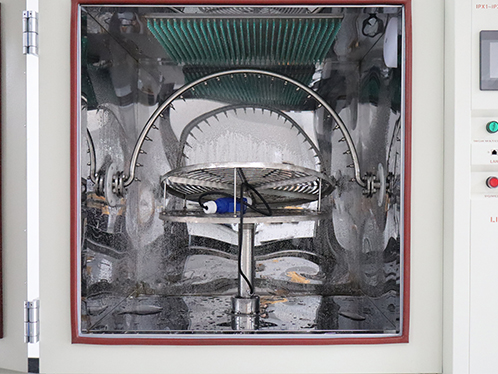
Robust Workroom |
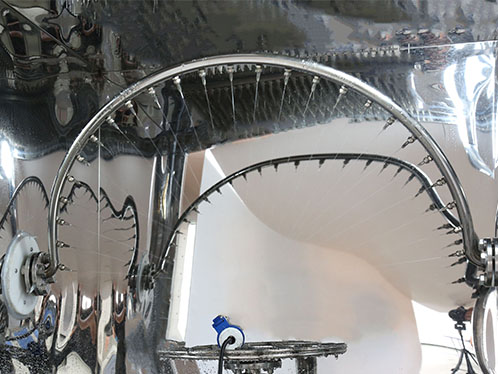
Oscillating tube |
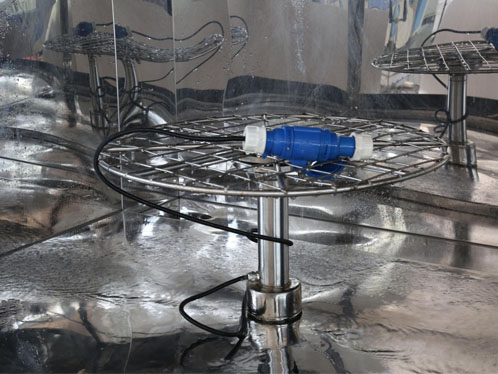
Turntable and power supply for sample |
One chamber can perform IPX1–IPX9 rain tests in accordance with IEC 60529, improving testing efficiency and saving laboratory space.
Accurate control of water flow, pressure, and spray angles ensures repeatable and reliable test results that meet international testing standards.
The inner chamber is made of SUS304 stainless steel, providing excellent durability and corrosion resistance during long-term wet testing.
Built-in power supply allows samples to operate during testing, enabling real-time monitoring of electrical performance and detecting failures immediately.
Equipped with a closed-loop water recycling and purification system to reduce water consumption and support sustainable laboratory operation.
Adjustable turntables and fixtures allow testing of various products such as lighting fixtures, electronic devices, and automotive components.
Programmable touch-screen controller with PC connectivity and Ethernet interface enables easy operation, data monitoring, and automated testing.
LIB provides 3-year warranty and lifetime technical support, ensuring long-term reliability and professional assistance for customers worldwide.
Neither is universally better. The better option depends on the test goal.
Choose a Rain Test Chamber when you need:
structured rain or ingress-related simulation
stronger repeatability
method-oriented testing
controlled spray geometry
validation for outdoor or water-resistant product performance
Choose a spray test chamber when you need:
general spray exposure
simpler internal screening
wash or splash simulation
lower-complexity testing
a broader, less method-specific spray process
The correct decision comes from the testing requirement, not from marketing language.
The difference between a Rain Test Chamber and a spray test chamber comes down to precision, purpose, and test structure. A Rain Test Chamber usually refers to a more defined system for rainfall or water-ingress-related evaluation. A spray test chamber is a broader term that may describe anything from a simple spray exposure unit to a more advanced water test system.
For buyers, the most practical approach is to define the test objective first, then compare the chamber's actual water delivery method, controllability, specimen setup, and suitability for your workflow. That process leads to a better decision than comparing names alone.
If your team is selecting equipment for product validation, ask the supplier to review your sample type, target test method, and intended evaluation criteria before choosing a model. That step can prevent an expensive mismatch and help ensure the chamber you buy supports real testing needs rather than just a familiar product label.