


In industries where product reliability is non-negotiable, the ability to accurately simulate extreme temperature changes is essential. A thermal chamber—also known as a thermal shock test chamber—is a precision laboratory instrument designed to recreate rapid and repeated transitions between high and low temperatures. By exposing products and materials to controlled thermal stress, manufacturers can evaluate performance, durability, and long-term reliability before products reach the market. Thermal chambers are widely used in electronics, automotive, aerospace, and material research to identify potential failures caused by temperature expansion, contraction, and sudden thermal shocks.
Proven performance in real-world applications further highlights the value of advanced thermal chamber solutions. A repeat customer from Saudi Arabia recently shared positive feedback on their LIB thermal chamber, noting that “the machine is working well” and confirming their decision to purchase additional spare parts for long-term operation. This continued cooperation and repeat order reflect both the reliability of the equipment and customer confidence in LIB Industry's product quality and after-sales support. Such real customer experiences demonstrate how a well-designed thermal chamber plays a critical role not only in testing accuracy, but also in long-term operational stability.

A thermal chamber, also known as an thermal shock test chamber, is a laboratory instrument that can precisely control temperature to simulate extreme temperature change conditions. They are used to test the performance, durability, and reliability of products and materials under extreme temperature change. The specimen is exposed to hot room and cold room alternatively. Achieving precise temperature control within a thermal chamber relies on a well-coordinated effort between several components. Heating elements or refrigeration units generate the desired temperature increase or decrease. Meanwhile, temperature sensors constantly monitor the internal environment, feeding real-time data to a control system.
How Thermal Chambers Work
Thermal chambers operate by integrating multiple systems that work together to create a stable, controllable, and repeatable temperature environment. Their primary purpose is to simulate real-world thermal conditions—both extreme and cyclical—so that products can be evaluated for performance, durability, and reliability. The precise temperature control inside a thermal chamber is achieved through the coordinated operation of heating and cooling components, temperature sensors, and an intelligent control system. The core function of a thermal chamber relies on three main principles working together to achieve precise temperature control:
● Heating and Cooling Systems
Thermal chambers are equipped with electric heaters and mechanical refrigeration systems to generate both high and low temperatures. Powerful circulation fans continuously move air throughout the chamber, ensuring uniform temperature distribution and minimizing thermal gradients. This uniform airflow is essential for accurate testing, as it guarantees that all areas of the specimen are exposed to the same thermal conditions. Advanced chambers are designed to achieve rapid temperature ramp rates while maintaining stability, allowing them to simulate harsh environmental changes encountered during storage, transportation, or operation.
● Temperature Sensors
High-precision temperature sensors are strategically installed inside the chamber to continuously monitor internal conditions. These sensors detect even slight temperature variations and transmit real-time data to the control system. Their accuracy and response speed are critical, as they directly affect temperature stability, repeatability, and overall test reliability. Proper sensor placement also ensures that measured temperatures accurately reflect the conditions experienced by the test specimen.
● Control System
The control system acts as the command center of the thermal chamber. It compares real-time temperature data with the programmed setpoint and uses a Proportional-Integral-Derivative (PID) control algorithm to regulate heating and cooling output. This dynamic adjustment allows the chamber to quickly reach target temperatures, minimize overshoot, and maintain precise control throughout the test cycle.
Types of Thermal Chambers
Thermal chambers are available in different configurations to meet diverse testing requirements across industries. Each type is designed to simulate specific temperature conditions and stress patterns, enabling manufacturers to evaluate product reliability under controlled thermal environments.
● 2-Zones Thermal Chamber
A 2-zones thermal chamber consists of a hot zone and a cold zone, each maintained at a constant temperature. During testing, the specimen is transferred between these two zones—usually by a basket or mechanical transfer system—to create repeated hot–cold cycles. This design is particularly effective for thermal cycling tests, where gradual yet repeated expansion and contraction can reveal material fatigue, solder joint failure, or structural weaknesses. These chambers are widely used in electronics, automotive components, and material testing to assess long-term durability under fluctuating temperatures.
● 3-Zones Thermal Chamber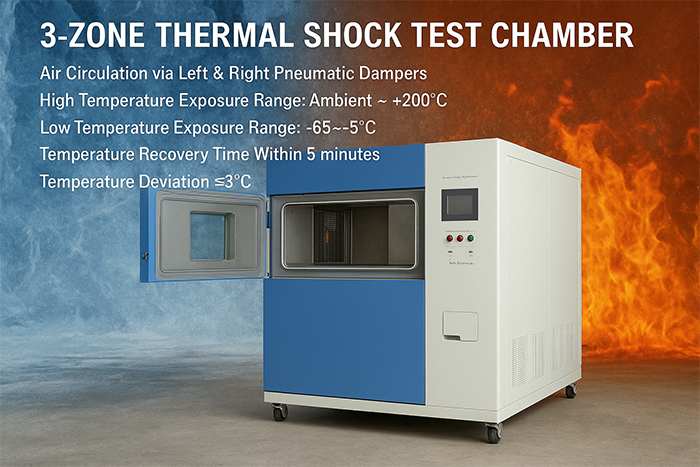
A 3-zones thermal chamber is designed for rapid thermal shock testing. Unlike the 2-zones design, the specimen remains stationary in a central test zone while hot and cold air is alternately introduced from adjacent zones through pneumatic dampers. This configuration enables extremely fast temperature transitions, placing severe thermal stress on the product. Thermal shock chambers are ideal for identifying failures caused by sudden temperature changes, such as cracking, delamination, or loss of electrical performance, ensuring products can withstand abrupt environmental shifts.
Function of a Thermal Chamber
Thermal chambers play a critical role in product development, quality assurance, and reliability testing across numerous industries. Their primary function is to expose products and materials to controlled temperature extremes in order to identify potential failures before they occur in real-world applications.
 |  | ||||
Model | TS-162 | TS-340 | TS-500 | TS-1000 | |
Internal Dimensions (mm) | 300*300*250 | 450*450*360 | 650*650*500 | 850*850*700 | |
Overall Dimension (mm) | 1560*870*1545 | 1710*1020*1845 | 1910*1220*2265 | 2110*1420*2665 | |
Interior Volume (mm) | 22L | 72L | 211L | 505L | |
Loading Capacity | 20kg | 30kg | 50kg | 60kg | |
Pre-heat Room | Upper limit Temperature | +220℃ | |||
Heating Time | Ambient ~ + 200℃, within 30 minutes | ||||
Pre-cool Room | Lower limit Temperature | -75℃ | |||
Cooling time | Ambient ~ -70℃, within 30 minutes | ||||
Test Room | High Temperature Exposure Range | Ambient +20 ~ +200°C | |||
Low temperature Exposure Range | –65 ~ -5°C | ||||
Temperature Fluctuation | ≤±0.5℃ | ||||
Temperature Deviation | ≤±3 ℃ | ||||
Temperature Recovery Time | Within 5 minutes | ||||
Cooling System | Mechanical compression refrigeration system | ||||
Refrigerating Unit | French TECUMSEH compressor | ||||
Controller | Programmable color LCD touch screen controller Ethernet connection, PC Link | ||||
Safety Device | Over-temperature protection, Over-current protection; Refrigerant high-pressure protection; Earth leakage protection | ||||
Exterior Material | Steel Plate with protective coating | ||||
Interior Material | SUS304 stainless steel | ||||
● Electronics Testing
Electronic components such as printed circuit boards, batteries, sensors, and semiconductor devices are highly sensitive to temperature variations. Thermal chambers are used to verify that these components operate reliably under high and low temperature conditions, preventing overheating, electrical instability, or performance degradation. This testing is essential for ensuring product safety and longevity.
● Material Stress Testing
Materials used in construction, aerospace, and manufacturing are subjected to thermal chambers to evaluate their resistance to thermal stress. Exposure to extreme temperatures helps engineers detect weaknesses such as cracking, warping, or loss of mechanical strength, allowing for design optimization and material selection improvements.
● Automotive Industry
In the automotive sector, thermal chambers are used to test components such as lighting systems, dashboards, sensors, and electronic control units. These tests ensure that vehicle parts can withstand temperature shocks and maintain reliable performance in diverse climate conditions.
Standards
To ensure accuracy, consistency, and international acceptance of test results, thermal chambers are designed and operated in compliance with recognized international standards. These standards define performance requirements, calibration procedures, and quality management practices for thermal testing.
● ISO/IEC 17025
This standard specifies the general requirements for the competence of testing and calibration laboratories. Compliance ensures that thermal testing is performed using validated methods, calibrated equipment, and reliable measurement systems.
● ISO 8946-2
ISO 8946-2 focuses on the performance verification of temperature-controlled chambers used for testing plastics. It defines test methods and evaluation criteria to ensure consistent and repeatable temperature exposure.
● ISO 145-20
This standard governs calibration methods for temperature and humidity chambers, ensuring measurement accuracy and traceability. Adherence to these standards guarantees that thermal chambers operate with high precision, reliability, and in line with industry best practices.
Conclusion
Thermal chambers are a popular tool in industries that requires meticulous control over temperature testing and research. Their versatile design and functionalities allow for a comprehensive evaluation of product performance under diverse thermal conditions. With adherence to rigorous standards like ISO certifications, the results obtained from thermal chamber testing carry global credibility, contributing to product optimization, and safety. As technology advances, thermal chambers continue to evolve, offering broader capabilities and application possibilities.
Looking for a reliable thermal chamber solution tailored to your testing needs? Contact LIB Industry today to receive professional technical support, detailed specifications, and an official quotation. Our experienced team is ready to help you ensure product reliability with confidence.


