
Views: 0 Author: Site Editor Publish Time: 2026-04-30 Origin: Site


Material degradation from ultraviolet light exposure is a leading cause of premature product failure, resulting in massive warranty claims and severe brand damage for manufacturers worldwide. Every year, prolonged sunlight exposure ruins countless polymers, coatings, and specialized components before their expected lifespan ends. While natural outdoor weathering provides valuable baseline data, modern product development lifecycles require much faster, highly reproducible testing environments. You simply cannot wait years to see how a new polymer blend holds up in the desert sun.
A recent real-world feedback from a customer in Serbia further reinforces the reliability of UV accelerated testing in daily laboratory operation. The client reported that the UV test chamber has been running smoothly without any issues and has been actively used by their Quality team. They confirmed all UV tests were completed successfully and highlighted strong satisfaction with system stability and technical support, stating: “These chambers are used by our Quality colleagues. So far, we didn’t have any problems with the UV chamber and all tests were completed without issues. Thank you for the excellent support.” This kind of consistent operational performance demonstrates the value of a stable and reliable UV Test Chamber in continuous industrial use.
A UV Test Chamber shifts weathering from unpredictable field observation to a controlled, quantifiable laboratory process. It allows manufacturers to evaluate material durability rapidly. They can ensure strict compliance with global industry standards. Ultimately, this equipment helps you forecast accurate product lifespans long before market release, saving both time and reputation.
① Primary Function: Simulates short-wave ultraviolet radiation, temperature fluctuations, and moisture to accelerate weathering and predict material degradation.
② Risk Mitigation: Validates product formulations against industry standards (e.g., ASTM, ISO) to prevent field failures.
③ Core Applications: Extensively used in plastics, coatings, automotive exteriors, and specialized electronics, including testing encapsulants and backsheets in a UV test chamber for PV solar panels.
④ Buying Decision: Selecting the right chamber depends heavily on matching lamp types (UVA vs. UVB) and moisture simulation capabilities to specific product failure modes.
Speed is critical in modern manufacturing. Traditional outdoor weathering takes months or even years to yield actionable data. You place samples on a rack and wait for the sun, rain, and temperature shifts to do their work. This slow timeline severely bottlenecks new product releases. Accelerated laboratory testing compresses this timeline dramatically. You can gather equivalent degradation data in mere days or weeks. This rapid feedback loop empowers engineering teams to iterate faster and launch products ahead of competitors.
Field testing also lacks environmental consistency. Nature is inherently unpredictable. Sunlight intensity varies daily. Rainfall and humidity levels constantly shift. You cannot easily compare test results from a cloudy spring to a scorching summer. In contrast, lab equipment provides strict, unyielding variable control. Test operators can precisely dictate irradiance levels, chamber temperature, and moisture cycles. This strict control establishes the highly reliable QA/QC baselines necessary for global manufacturing.
You must also weigh the equipment capital expenditure against the massive financial liabilities of product failures. Mass product recalls drain company finances. UV-induced embrittlement causes structural snapping. Color fading destroys consumer trust in premium brands. Investing in testing hardware prevents these expensive disasters. You pay a predictable upfront price to avoid catastrophic field failures later. Quality costs represent a necessary investment in long-term brand survival.
Different industries face unique weathering challenges. We see testing hardware deployed across various sectors to mimic specific environmental stresses.
Sunlight aggressively attacks the molecular chains in plastics. Continuous exposure leads to severe structural integrity loss. Surfaces often develop a white, powdery residue known as chalking. Eventually, the material suffers from complete embrittlement. Embrittled plastics shatter under minimal physical stress. Testers subject polymer samples to continuous radiation to evaluate these specific degradation stages before finalizing chemical formulations.
Coatings serve as both an aesthetic finish and a critical protective barrier. Manufacturers subject these layers to cyclical light and condensation. They test for gloss retention to ensure products stay shiny over time. They monitor colorfastness to prevent ugly fading on retail shelves. Most importantly, they check for delamination. Peeling paint exposes underlying metals to rapid rust and decay.
Solar energy arrays endure decades of relentless sunlight exposure. We must closely examine the specific requirements of a UV Test Chamber For PV Solar Panel manufacturing. Engineers focus heavily on evaluating the long-term durability of EVA encapsulants. They also test protective backsheets and specialized glass layers. These components face intense, prolonged exposure on rooftops and open fields. Rigorous testing ensures they will not yellow, crack, or degrade over their expected 25-year lifespans.
Car interiors and exteriors bake in the sun daily. Dashboards sit under magnifying windshield glass. Seat fabrics absorb continuous radiation. Automotive brands must verify the tensile strength and aesthetic longevity of these materials. Continuous exposure testing ensures threads do not snap and vibrant trim colors do not turn dull after just a few years of outdoor deployment.
Hardware selection directly dictates your data quality. You must match specific fluorescent lamp types to your anticipated product failure modes to get useful insights.
These lamps perfectly mimic sunlight in the critical short-wave region. They cover the spectrum from 365 nm down to the solar cutoff of 295 nm. They produce almost no energy below this natural threshold. This makes them the best choice for predicting actual outdoor performance. When you need high-confidence correlations to real-world aging, you choose UVA.
Sometimes you need answers immediately. UVB-313 lamps utilize shorter wavelengths for severe, rapid quality control testing. They accelerate damage much faster than UVA lamps. However, you must interpret these results carefully. UVB radiation can cause unnatural material degradation. You might see polymer breakdown types never actually found in real-world environments. Use them for fast comparative screening rather than exact lifespan prediction.
Light alone does not destroy materials. Water plays an equally destructive role outdoors. High-quality hardware contrasts different wetness mechanisms. Condensation systems simulate realistic nighttime dew. Dew remains on outdoor products for hours, deeply penetrating molecular structures. Alternatively, water spray features simulate rain erosion. Spray cycles also introduce thermal shock. The sudden temperature drop from a cold spray onto a hot baked surface causes rapid material fatigue and microscopic cracking.
Below is a summary table comparing the primary lamp technologies:
Lamp Type | Primary Wavelength Focus | Simulation Goal | Best Use Case | Drawbacks |
|---|---|---|---|---|
UVA-340 | 295 nm to 365 nm | Realistic outdoor sunlight | Accurate lifespan prediction | Slower degradation testing |
UVB-313 | Below 295 nm | Maximum acceleration | Fast QA/QC comparative screening | May cause unnatural anomalies |
| Model | UV-SI-260 UV Test Chamber | 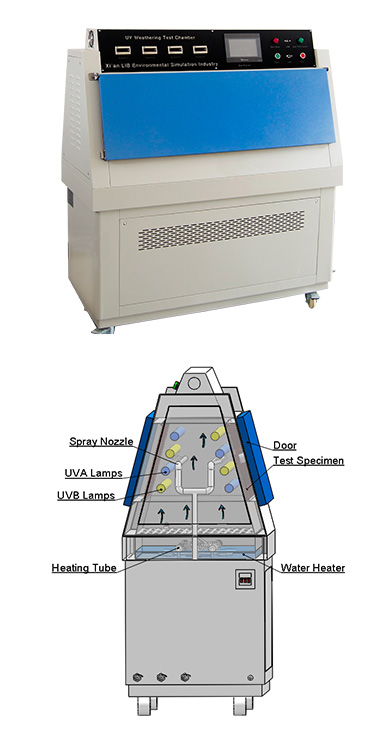 |
| Internal Dimension (mm) | 450*1170*500 | |
| Overall Dimension (mm) | 610*1330*1470 | |
| Specimen Holder Size(mm) | 75*150 | |
| Specimen Capacity | 52 Pieces | |
| Irradiation Source | Fluorescent UV lamps (8) - 40 W | |
| Temperature Range | Ambient ~ 90 ℃ ±2℃ | |
| Black Panel Temperature (BPT) | 35 ~ 80 ℃ | |
| Humidity Range | ≥95% RH | |
| Bandwidth | 290 ~ 400nm | |
| Irradiance Control | 0.3~20 W/㎡ | |
| Water Spray Cycle | 1~9999H59M (Adjustable) | |
| Distance of Specimen and lamp | 50mm | |
| Controller | Programmable color LCD touch screen controller, Ethernet connection | |
| Water Supply System | Automatic water supply, Water purification system | |
| Safety Device | Over-temperature Protection; Over-current Protection; | |
| Water Shortage Protection; Earth leakage Protection; Phase Sequence Protection | ||
| Exterior Material | Steel Plate with protective coating | |
| Interior Material | SUS304 Stainless Steel |
Buying the right lab equipment requires careful technical evaluation. You should look beyond basic specifications to understand the long-term reliability of the machine.
Lamp output degrades naturally over time. Without intervention, your light intensity drops. You need closed-loop feedback systems to maintain constant irradiance. Electronic eye sensors continuously monitor the light output. They automatically adjust power to the lamps as they age. This mechanism ensures your test conditions remain exactly the same on day one and day fifty.
Your hardware must meet international testing benchmarks. You must verify if the chamber's software can natively run specific testing cycles without manual programming workarounds.
ASTM G154: The standard practice for operating fluorescent light apparatus for UV exposure of nonmetallic materials.
ISO 4892-3: Specifies methods for exposing specimens to fluorescent UV radiation, heat, and water.
SAE J2020: An automotive standard focusing heavily on exterior plastics and exterior trim components.
Regulated industries require strict proof of testing. You must carefully evaluate the software interface before buying. Good software tracks historical test data seamlessly. It easily exports compliance reports for your clients or auditors. Furthermore, it maintains tight security protocols to prevent operators from tampering with active test parameters.
Laboratory floor space always carries a premium. You must balance your daily sample volume needs against physical room dimensions. Calculate your daily testing throughput carefully. Consider power requirements alongside physical size to ensure your facility can handle the electrical load.
The chart below outlines typical capacity tiers for procurement planning:
Chamber Class | Typical Sample Capacity | Lab Footprint Space | Ideal User Profile |
|---|---|---|---|
Benchtop Unit | Under 25 flat panels | Minimal (Fits on standard desk) | Small R&D labs, boutique chemical companies |
Standard Floor Model | 40 to 60 standard panels | Moderate (Size of a large refrigerator) | Mid-sized manufacturing, dedicated QA teams |
High-Capacity Custom | 100+ panels or 3D objects | Large (Requires dedicated room space) | Automotive tier-1 suppliers, aerospace testing |
LIB Popular Fastness Test Instruments | ||
|
|
|
A: Testing durations vary wildly depending on the specific material and the targeted standard. There is no absolute, universal timeframe. Most basic tests run anywhere from a few hundred to several thousand hours. A standard automotive coating might endure a strict 2,000-hour cycle, while a simple packaging plastic may fail in just 200 hours.
A: No testing hardware offers a perfect one-to-one conversion rate for exact outdoor lifespans. Geographic weather variations, localized pollution, and unexpected extreme events make absolute prediction impossible. Instead, these tests provide vital comparative data. They confidently tell you if formulation A will outlast formulation B under identical harsh conditions.
A: A Xenon arc machine simulates the entire sunlight spectrum, including visible light and infrared heat. It is excellent for testing overall color fading and thermal stress. Conversely, a fluorescent chamber focuses specifically on the short-wave ultraviolet spectrum. This specific spectrum is responsible for the vast majority of severe polymer degradation and structural failure.


