


Most industrial products must undergo salt spray corrosion tests, especially products produced in the automotive industry. Employ salt spray tests to simulate the corrosion of automotive parts in the atmospheric environment, and scientifically evaluate the performance of components in all aspects. In this passage LIB introduces the concept, types and characteristics of salt spray test, and analyzes the standard method of circulating salt spray for automotive materials, then finally in-depth study of single-phase test and comprehensive salt spray corrosion test in the automotive industry, hoping to provide certain reference for salt spray corrosion test for automotive industry customers.
Salt spray corrosion test can simulate salt spray corrosion in the atmospheric environment, and accelerate the entire corrosion progress, and the test results can be obtained in a short time, which plays an important role in the automotive industry and can test the reliability and quality of products. The initial type of salt spray test is neutral salt spray test, corrosion environment close to neutral, on the basis of various tests, such as ASS, CASS, etc., the subsequent development of alternating salt spray test, can cycle humid heat, salt spray and drying and other stages, to achieve the alternating conversion of various environments, can effectively test product performance, at this stage has appeared a variety of salt spray corrosion test standard methods, suitable for testing different automotive parts.
Recently, a valued automotive customer shared positive feedback after implementing the LIB Cyclic Salt Spray Corrosion Chamber in their lab. They reported stable operation, accurate environmental control, and consistent test results across multiple corrosion cycles. The chamber’s ability to automatically switch between salt spray, drying, and humid heat stages significantly improved their testing efficiency and reduced manual intervention. This real-world validation highlights how reliable equipment directly supports quality assurance and product durability in demanding automotive applications.
Salt Spray Corrosion
Salt spray is a common atmospheric corrosion, existing in the natural environment, corrosion damage is relatively strong. Salt spray contains a large number of chloride ions, will directly penetrate the surface of the metal material, oxidation and protective layer can not block chloride ions, after crossing the surface of the material, will have an electrochemical reaction with the metal, causing huge damage to the material, surface corrosion will also change the original properties, long-term corrosion will also be through the voids and cracks into the product inside, further corrosion.
Salt Spray Test
Salt spray corrosion has great damage to metal materials. In order to reduce salt spray corrosion, salt spray tests can be carried out to simulate the state of atmospheric salt spray corrosion in the laboratory. Compared with the natural environment, the salt spray corrosion simulated in the laboratory is stronger , the chloride concentration can reach several times to dozens of times that of the atmospheric environment, which can quickly show the corrosion of metal materials in the laboratory. The corrosion situation in the natural environment can be simulated for 1 year in the laboratory in 24 hours, which can greatly shorten the experiment time, and the simulation experiment results are more accurate. During the salt spray test, a large number of professional simulation equipment will be equipped in the laboratory. It is a kind of environmental test to realize the monitoring of salt spray environmental conditions.
Types of Salt Spray Test
1. Neutral salt spray test
At this stage, the most commonly used test method is the neutral salt spray test, which is also the earliest test method. During the neutral salt spray test, salt spray shall be provided continuously, the temperature shall be around 35°C, and the humidity shall be above 95%. Use sodium chloride brine (5% concentration) to make 1-2mL/(h·80 cm2) settlement, and the salt spray is deposited on the surface of the specimen, and then the test time is determined according to the actual needs to determine the corrosion situation.
2.Acetic salt spray test
On the basis of theneutral salt spray test, the acetic acid salt spray test was developed. The test conditions are basically the same as the neutral salt spray test, but a certain amount of glacial acetic acid must be added to adjust the PH and quickly reduce the pH. The pH of the laboratory is adjusted to be acidic (the PH value is about 3), so that the nature of the salt spray changes, and the tested object is in an acidic salt spray environment, and the corrosion rate is accelerated, which can reach 3 times the speed of the neutral salt spray test.
3. Copper-accelerated acetate spray test
In recent years, the world's economy has developed rapidly, and it has also driven industrial development. The corrosion rate of salt spray tests needs to be continuously accelerated. Therefore, more product tests adopt copper-accelerated acetate salt spray tests, and the test temperature is raised to 50 ℃. Adding a small amount of copper chloride to sodium chloride solution can greatly increase the degree of corrosion. At the same time, the pH value is generally set at 3.1 to 3.3, the corrosion degree exceeds the acetic acid salt spray test, and the corrosion rate can reach about 8 times that of the neutral salt spray test.
4. Alternating salt spray test
The alternating salt spray test is a comprehensive test. Different test conditions are used comprehensively, and the cycle is combined in the laboratory, which can make the simulated environment closer to real life. The tested parts are in a humid environment, which not only corrodes the surface, but also damages the product. There is a certain amount of corrosion inside. During the alternating salt spray test, two environments will be switched alternately, one is a salt spray environment, and the other is a humid and hot environment. After the simulation test is completed, the electrical and mechanical properties can be tested.
Characteristics of Cyclic Corrosion Salt Spray Test
1. Acceleration
The acceleration of the cyclic corrosion salt spray test is mainly reflected in three aspects.
1) Continuous spraying of salt mist to ensure continuous surface corrosion. During the cyclic salt spray corrosion process, a certain amount of salt spray will be sprayed out, and a series of changes will appear on the specimen, including rust, bubbles, etc., and the salt spray is continuously supplied during this process, which can continuously corrode the specimen .
2) The accumulation of salt mist in the hot and humid stage will spread to the inside of the tested part. After the specimen enters the hot and humid stage, although no salt spray is sprayed on the surface, the accumulated salt spray will still adhere to the surface of the specimen, penetrate into the interior under the hot and humid environment, and deeply corrode the specimen.
3) The drying stage accelerates the surface corrosion rate. After the specimen enters the drying stage, the relative humidity will gradually decrease, which increases the concentration of the salt solution, which is more corrosive and accelerates the corrosion of the specimen.
During the cyclic corrosion salt spray test, the specimen is always in a state of cyclical alternation. The traditional salt spray test method is too simple, and only severe corrosion occurs on the surface of the specimen. Although it will penetrate into the interior, the corrosion simulation will deviate from the reality. The cyclical alternating corrosion cycle alternates the three states of dryness, heat and humidity, and salt spray. The simulated environment is closer to reality, which speeds up the test and makes the test results more accurate and real.
2. Complexity
The environment simulated by the cyclic salt spray test is closer to the atmospheric environment, and there are many cyclic components, which can be reasonably selected according to the actual test requirements, as close as possible to the use environment, and the complexity of the test is higher. Since cyclic salt spray corrosion needs to switch multiple cycle combinations, special operators need to be arranged for this. In recent years, with the continuous improvement of technology level, a single test chamber can be used to complete all test tasks
Standard Method for Cyclic Salt Spray for Automotive Materials
Cyclic salt spray testwas first applied in the automobile industry, which can effectively evaluate the reliability of products. There are mainly three standard methods of cyclic salt spray as follows.
1. CCT cycle
This method is mainly based on the neutral salt spray method, adding two links of drying and damp heat. After several optimizations and improvements, it has developed to CCT IV. It is also a method recognized by the industry at present. It is mainly used for testing automobile steel plates and parts. The humid heat condition is 60°C and 95% for 75 minutes, the drying temperature and humidity are below 60°C and 30% for 160 minutes, and then goes through the humid heat stage again.
2. GMW 14872
This method was first applied in the United States. It adopts superimposed environmental combination. The ambient temperature is 25°C and 45% relative humidity. After 8 hours, it enters the humid heat stage, and then enters the drying stage. This method can add salt spray according to the actual environment, and can also add factors such as mechanical shock, grit, etc., the number of cycles can be selected in conjunction with automotive test components when selecting this method.
3. SAE J2334
This method is an internationally issued standard method. The temperature is 25 °C, the relative humidity is 45%, and it lasts for 8 hours to enter the humid heat stage. This method takes a long time to dry and is generally used to test automotive paint products.
Single and Comprehensive LIB Salt Spray and Corrosion Tests in The Automotive Industry
With the advancement of science and technology, people put forward higher requirements for the quality of automobile products. No matter in the design, research and development stages, it is necessary to strengthen the reasonable use of inspection methods. In the design stage, while paying attention to product functions, it is also necessary to pay attention to the service life. However, it is impossible to observe product performance in a short time in the daily environment, and a long observation time is required, which requires the use of salt spray corrosion tests, especially automotive products are exposed to the air most of the time, and salt spray corrosion is inevitable.
| Model | SC-010 | SC-016 | SC-020 |
| Internal dimensions (mm) | 1300*1000*600 | 1600*900*720 | 2000*1000*800 |
| Overall dimensions (mm) | 2000*1300*1600 | 2300*1300*1700 | 2700*1300*1900 |
| Interior Volume (L) | 780 | 1280 | 1800 |
| Temperature Range | +10 ℃ ~ +90 ℃ | ||
| Temperature Fluctuation | ± 0.5 ℃ | ||
| Temperature Deviation | ± 2.0 ℃ | ||
| Humidity Range | 30% ~ 98% RH | ||
| Humidity Deviation | + 2%, - 3% | ||
| Salt Fog Deposition | 1~2ml / 80cm2 · h | ||
| Cooling system | Mechanical compression refrigeration system | ||
| Humidifier | External isolation, stainless steel surface evaporation humidifier | ||
| Water supply system | Water purification system | ||
| Air Preheating | Saturated air barrel (31Liter) | ||
| Spraying System | Atomizer tower and Spray nozzles | ||
| Salt Fog Collected | Fog collector and fog measure cylinder | ||
| Controller | Programmable color LCD touch screen controller, Ethernet connection | ||
| Air Circulation | Centrifugal wind fan | ||
| Safety Device | Humidifier Dry-combustion Protection; Over-temperature Protection; Over-current Protection; | ||
| Water Shortage Protection; Earth leakage Protection | |||
| Material | Glass fiber reinforced plastics | ||
| Standard Configuration | 8 round bars | ||
Cyclic Salt Spray Corrosion Chamber |   | ||

Single test
At this stage, automobile industry mainly adopts individual tests, among which the more critical test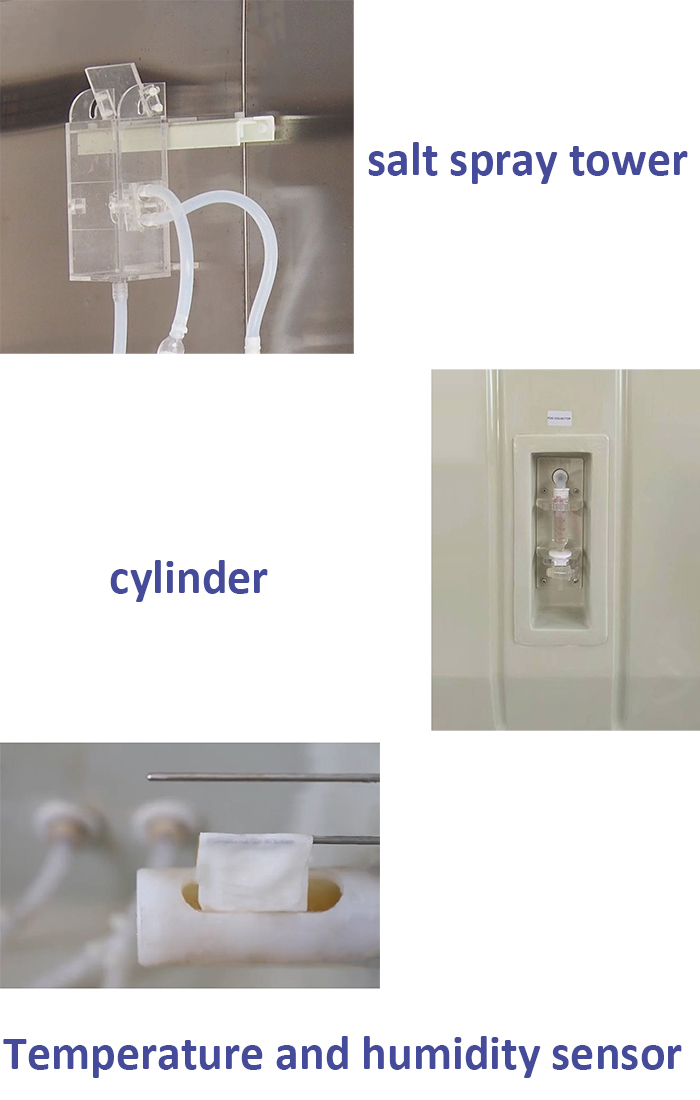 items include condensation test, salt spray test, etc. Although the condensation test is simple to operate, the accuracy of the results cannot be guaranteed, and the actual results are closely related to the test sequence. In the two cases of long-term humidity and condensation moisture evaporation, completely different experimental results will be obtained, and the salt spray test will change the corrosion type according to the auto parts, so there is a serious problem in the single test, although a large number of similar test pieces can be repeated, The purpose of compensation is achieved, but the correlation between the laboratory simulation environment and the atmospheric environment cannot be guaranteed. At the very beginning, a German business association began to study the salt spray test. The main research direction was the correlation between the test environment and the atmospheric environment.
At the same time, a series of standards were formulated based on the results obtained from the research. For example, when testing the car paint process, it is necessary to choose to simulate the corrosion state during the driving of the car, focusing on the joints, edges and other positions.
Existing studies have shown that the effect of the laboratory salt spray test meets the test requirements and speeds up the progress of the test simulation. When testing according to the test standard, the time can be greatly shortened. For example, it takes 4 to 6 weeks to test automotive components in an atmospheric environment, but The test can be completed after 4 to 6 cycles of the salt spray test. Even if the component has a multi-layer structure, the corrosion process of the component can be well simulated, and a single cycle can reach the effect of the atmospheric environment test for 3 weeks.
If you test the igniter in the inner cavity of the car body, this cycle is equivalent to the effect of testing for 2 weeks in the atmospheric environment. Although the effect of individual tests is relatively good, it still cannot meet all the test requirements of automotive components, so there are comprehensive tests, alternating tests, etc. .
2. Comprehensive test
The comprehensive test is developed on the basis of a single test, adding many different simulated environments, mainly salt spray stage, dry stage and humid heat stage. Different combination stages can be cycled alternately, which can make the laboratory environment closer to the reality, and can also achieve the purpose of speeding up the test. At this stage, a large number of standard methods of circulating salt spray for automotive materials have appeared in the world, such as CCT cycle, GMW 14872, SAE J2334, PV 1210, etc., which can be selected according to actual needs. After determining the cyclic test method, it is necessary to take into account the test requirements of auto parts and determine the scientific test combination to achieve the expected test effect.
Contact LIB Industry today to upgrade your corrosion testing capability. Our team will help you select the right cyclic salt spray chamber to match your automotive testing standards and ensure reliable, repeatable results for your products.


