Views: 0 Author: Site Editor Publish Time: 2026-04-03 Origin: Site


If you are evaluating a Rain Test Chamber, the first thing to understand is that there is usually no single universal “rain test chamber certification” that covers every market, every machine, and every application. In most cases, the relevant standards fall into four different categories: electrical and machinery safety, test method standards, calibration and measurement practices, and market-access compliance requirements such as CE or similar regulatory markings.
This matters because many buyers ask whether a chamber is “certified,” when the more useful question is: certified for what, and according to which requirement? A Rain Test Chamber may need to meet safety and compliance rules as a piece of equipment, while also being capable of performing tests according to specific environmental or ingress-related standards.
In real procurement discussions, “certification” can mean several different things:
the chamber has passed electrical or machinery safety requirements
the chamber is manufactured under a quality management system
the chamber can perform tests aligned with a recognized standard
the chamber has instruments calibrated to accepted practices
the chamber is accepted for sale in a specific market
These are related, but they are not the same.
For example, a supplier may state that its Rain Test Chamber is CE marked or built under ISO 9001 processes. That does not automatically mean the chamber is validated for every ingress protection test your lab wants to run. On the other hand, a machine may be structurally suitable for a test method, but still require separate review for regulatory or electrical compliance in your region.
That is why buyers should separate equipment compliance, test capability, and measurement traceability instead of treating them as one item.
A Rain Test Chamber is an electrical test machine with water, controls, and mechanical components. That means product safety standards are usually one of the first areas to review.
Depending on the machine design and destination market, relevant requirements may include:
electrical safety requirements for industrial equipment
machinery safety principles
low-voltage compliance requirements
electromagnetic compatibility requirements
grounding, insulation, and protective system requirements
For many buyers, this part is more practical than theoretical. If the equipment will be installed in a regulated industrial or laboratory environment, the chamber often needs documentation showing that it meets the electrical and machinery rules required in that market.
This is especially important for import projects, multinational lab deployment, or installations where internal EHS or procurement teams require formal technical files.
This is the category most buyers think of first, but it is often misunderstood.
A Rain Test Chamber is usually selected so that it can perform water exposure tests aligned with recognized procedures. These are not always “certifications” of the chamber itself. In many cases, they are test standards that define how the test should be performed.
Depending on your application, these may involve:
enclosure protection testing
water ingress evaluation
rain simulation for outdoor equipment
environmental durability procedures
automotive or transport-sector water exposure methods
military or industry-specific rain test methods
The key point is this: a chamber is generally not certified by the test method alone. Instead, the chamber must be capable of meeting the setup, spray conditions, specimen positioning, and repeatability requirements of the relevant test method.
That distinction is critical during purchasing. A supplier may say a chamber is suitable for a certain standard, but the buyer still needs to confirm that the actual configuration supports the intended procedure.
If your lab uses a Rain Test Chamber for product qualification, validation, customer audits, or regulated quality processes, calibration and traceability are often just as important as the machine’s basic design.
Typical items requiring verification may include:
water flow or spray rate
pressure measurement
timing control
temperature, if relevant to the chamber design
turntable speed, if applicable
nozzle positioning or spray geometry checks
In practice, calibration requirements often depend on the lab’s own quality system, customer requirements, and the sensitivity of the test result. A chamber used for internal engineering comparison may be managed differently from one used in a formal accredited lab environment.
This is where buyers should be careful. A supplier statement such as “factory calibrated” may be helpful, but it is not always the same as calibration performed under the traceability requirements your organization expects.
Some buyers also ask whether the manufacturer is certified under a recognized quality management standard. This does not certify the Rain Test Chamber test performance directly, but it can still matter.
A supplier operating under a recognized quality management system may offer stronger control over:
design documentation
material traceability
assembly consistency
inspection records
corrective action processes
after-sales service management
For buyers comparing multiple suppliers, this can be a useful confidence factor, especially for custom equipment or export projects. However, it should not replace a technical review of the chamber itself.
These define the water exposure method the lab intends to perform. The relevant standard depends on the product and sector.
Examples of scenarios include:
validating enclosure resistance to water ingress
testing outdoor electronics under simulated rain
evaluating vehicle components exposed to splash or spray
performing sector-specific rain or water resistance procedures
| IP Testing Required for IEC 60529 Rating | |
| Dust (First Number) | Moisture (Second Number) |
| IP Ox - No Protection | IP x0 - No Protection |
| IP 1x - Objects > 50mm | IP x1 - Protected Against Vertically Dripping water |
| IP 2x - Objects > 12mm | IP x2 - Protected Against Dripping water (15°tilted) |
| IP 3x - Objects > 2.5mm | IP x3 - Protected Against Sprayed water |
| IP 4x - Objects > 1mm | IP x4 - Protected Against Splashed water |
| IP 5x - Dust Protected (Vacuum) | IP x5 - Protected Against water jets |
| IP 5x - Dust Protected (Non-Vacuum) | IP x6 - Protected Against Powerful water Jets |
| IP 6x - Dust Tight | IP x7 - Protected Against Effects of Temporary lmmersion |
| IP x8 - Protected Against Continuous Immersion | |
| IP x9 - Protected Against water with High Pressure/ Steam Jet Cleaning | |
This is one of the most important review points because a chamber can be compliant as a machine and still be unsuitable for your intended test method.
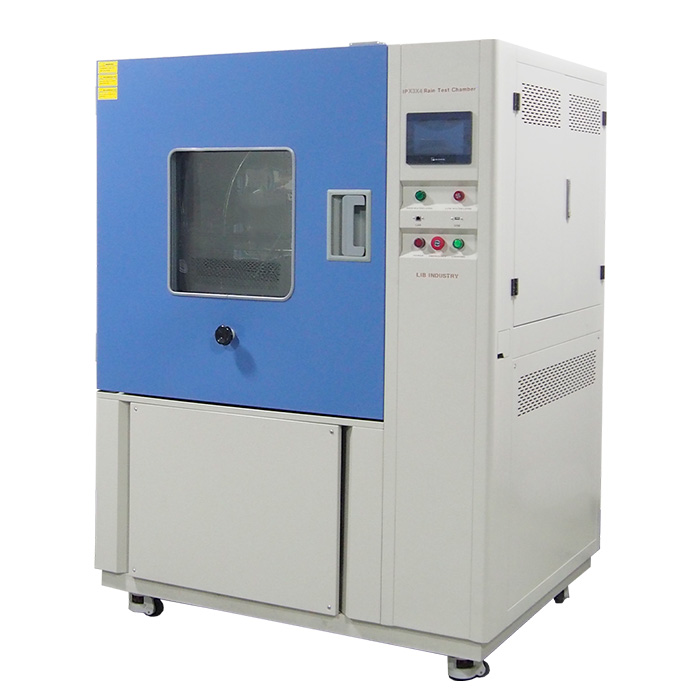
LIB Rain Test Chambers stand out by addressing these concerns comprehensively:
1. Multiple levels of rain simulation
Full IPX1–IPX9K coverage for dripping, spray, immersion, and high-pressure water tests
Includes MIL-STD water test chambers for military and industrial applications
2. Reliable environmental simulation
Temperature and humidity ranges from -70℃ to 150℃ and 20%–98% RH
Fast thermal shock with 2-zone or 3-zone chambers
Xenon arc and UV weathering options for light-accelerated aging
Sand, dust, and toxic gas simulation for comprehensive reliability testing
3. Compliance with standards
Supports IEC, ISO, ASTM, and MIL-STD procedures
Safe and compliant electrical and machinery design
Factory-calibrated instruments with traceable measurement options
4. Customized and secure solutions
Walk-in or benchtop chambers tailored to specific requirements
Three-year warranty with lifetime service and spare parts support
Secure export-ready packaging for sea, air, or rail transport
5. Integrated quality management
Controlled assembly, material traceability, and inspection documentation
Supports labs with internal calibration, operational checks, and preventive maintenance requirements
 |
| ||
| Model | R-800C | R-1200C | |
| Internal Dimensions (mm) | 900*900*900 | 1400*1400*1400 | |
| Overall Dimensions (mm) | 1120*1460*1660 | 1600*1950*2100 | |
| Interior Volume (L) | 720 | 2740 | |
| Parameter | Drip tray size (mm) | 600*600 | 900*900 |
| Spraying Hole Diameter | φ0.4mm | ||
| Hole Spacing | 50 mm | ||
| Swing Angle of Oscillating Tube | 0 ~ ±180° (Adjustable) | ||
| Turntable Rotation Speed | 1r/min (Adjustable) | ||
| Oscillating Tube Radius | 400mm | ||
| Water Pressure Control | Flow meter | 600mm | |
| Structure | Controller | Programmable color LCD touch screen controller | |
| Build-in Water Tank(mm) | Ethernet connection, PC Link, USB | ||
| 370*375*950 | |||
| View Window Size(mm) | 475*475 | ||
| Water supply system | Water tank, booster pump, Automatic water supply, Water purification system | ||
| Safety Device | Over-temperature Protection; Over-current Protection; Water Shortage Protection; Earth leakage Protection; Phase Sequence Protection | ||
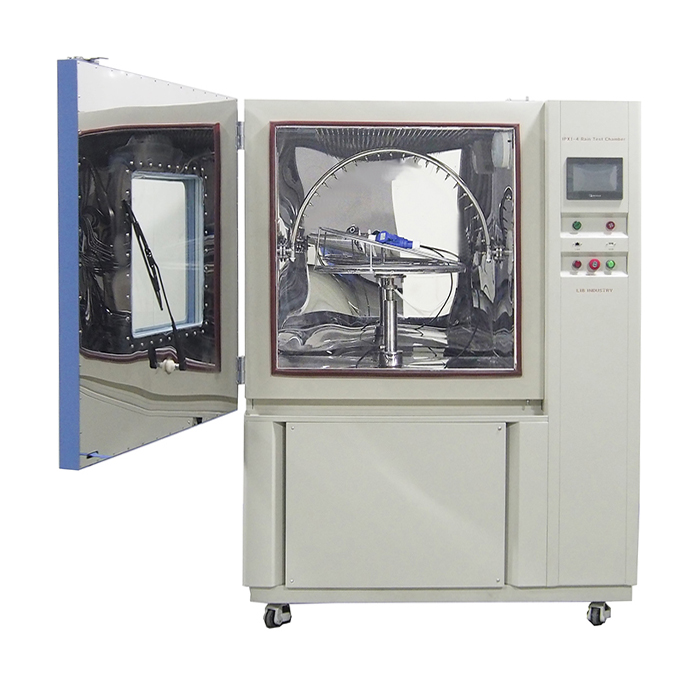
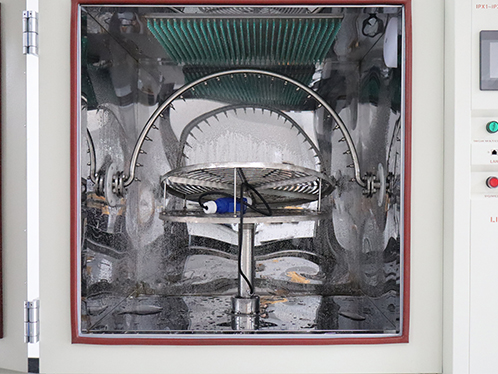
Robust Workroom |
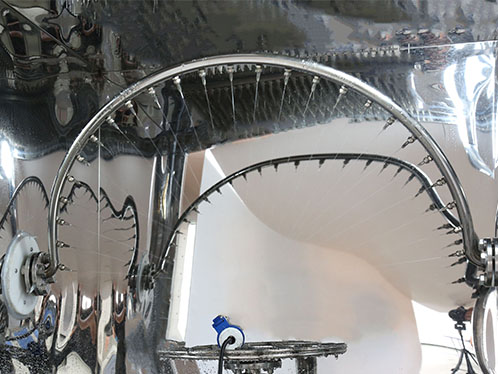
Oscillating tube |
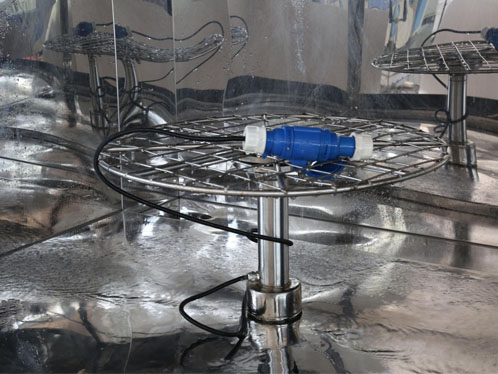
Turntable and power supply for sample |
LIB Rain Test Chambers stand out by addressing these concerns comprehensively:
1. Multiple levels of rain simulation
Full IPX1–IPX9K coverage for dripping, spray, immersion, and high-pressure water tests
Includes MIL-STD water test chambers for military and industrial applications
2. Reliable environmental simulation
Temperature and humidity ranges from -70℃ to 150℃ and 20%–98% RH
Fast thermal shock with 2-zone or 3-zone chambers
Xenon arc and UV weathering options for light-accelerated aging
Sand, dust, and toxic gas simulation for comprehensive reliability testing
3. Compliance with standards
Supports IEC, ISO, ASTM, and MIL-STD procedures
Safe and compliant electrical and machinery design
Factory-calibrated instruments with traceable measurement options
4. Customized and secure solutions
Walk-in or benchtop chambers tailored to specific requirements
Three-year warranty with lifetime service and spare parts support
Secure export-ready packaging for sea, air, or rail transport
5. Integrated quality management
Controlled assembly, material traceability, and inspection documentation
Supports labs with internal calibration, operational checks, and preventive maintenance requirements
A practical review process usually includes these questions.
Ask what declarations, conformity documents, safety information, and electrical documentation are available.
Do not stop at a general statement such as “supports IP testing” or “meets rain test requirements.” Ask how the machine is configured to do so.
Review pressure, flow, timing, temperature, turntable movement, and any other variables relevant to your test.
Ask whether the instruments are factory checked, formally calibrated, or traceable to recognized references, and clarify what evidence is provided.
A reliable supplier should be able to explain whether it is claiming regulatory compliance, test-method suitability, calibration support, or all of these separately.
There is no single answer for every buyer. The most important standard depends on your actual use case.
If you are importing equipment, market-access and electrical compliance may be the first priority. If you run a validation lab, method suitability and calibration traceability may matter more. If you supply to regulated customers, internal audit expectations may drive the final requirement.
For most projects, the right approach is to review the Rain Test Chamber under three separate lenses:
Is it compliant and safe as a machine?
Is it technically suitable for the required water test method?
Is its measurement and control system documented well enough for our quality process?
That framework is more reliable than searching for one blanket certification label.
When people ask what standards apply to Rain Test Chamber certification, the practical answer is that several different standards may apply, and they serve different purposes. Some govern electrical and machinery safety. Some define how rain or water exposure tests should be performed. Others support calibration, traceability, or quality-system expectations.
For buyers and labs, the safest path is to avoid treating “certification” as a single checkbox. Instead, confirm the chamber's regulatory compliance, test-method suitability, calibration support, and documentation package separately.
If your application involves customer audits, accreditation, export requirements, or safety-sensitive product validation, it is wise to review the final standard list with your compliance team, lab manager, or qualified technical assessor before purchase. That extra step can prevent specification gaps and make the Rain Test Chamber much easier to approve, install, and use with confidence.
Contact LIB Industry today to discuss your testing requirements, explore our full range of Rain Test Chambers, and receive expert guidance on selecting the right chamber for your applications.